

[2026] Pass your AZ-204 exam with this 100% Free AZ-204 Braindump
View All AZ-204 Actual Exam Questions, Answers and Explanations for Free
Microsoft AZ-204 certification exam is designed for developers who want to demonstrate their skills in developing cloud-based solutions using Microsoft Azure. As more and more organizations move their operations to the cloud, there's a growing demand for developers who can build, deploy, and manage applications in the cloud. The AZ-204 certification exam is a great way for developers to showcase their expertise in this area and stay competitive in the job market.
NEW QUESTION # 145
You are developing an Azure function that connects to an Azure SQL Database instance. The function is triggered by an Azure Storage queue.
You receive reports of numerous System.InvalidOperationExceptions with the following message: "Timeout expired. The timeout period elapsed prior to obtaining a connection from the pool. This may have occurred because all pooled connections were in use and max pool size was reached."
You need to prevent the exception.
What should you do?
- A. In the function.json file, change the value of the type option to queueScaling
- B. In the host.json file, decrease the value of the batchSize option
- C. Convert the Azure Function to the Premium plan
- D. Convert the trigger to Azure Event Hub
Answer: C
Explanation:
With the Premium plan the max outbound connections per instance is unbounded compared to the 600 active (1200 total) in a Consumption plan.
Note: The number of available connections is limited partly because a function app runs in a sandbox environment. One of the restrictions that the sandbox imposes on your code is a limit on the number of outbound connections, which is currently 600 active (1,200 total) connections per instance. When you reach this limit, the functions runtime writes the following message to the logs: Host thresholds exceeded: Connections.
Reference:
https://docs.microsoft.com/en-us/azure/azure-functions/manage-connections
https://docs.microsoft.com/en-us/azure/azure-functions/functions-scale#service-limits
NEW QUESTION # 146
You need to implement the bindings for the CheckUserContent function.
How should you complete the code segment? To answer, select the appropriate options in the answer area.
NOTE:Each correct selection is worth one point.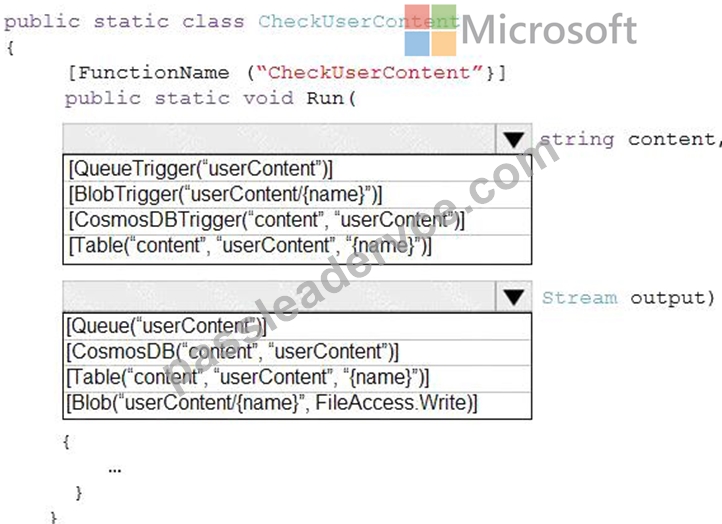
Answer:
Explanation: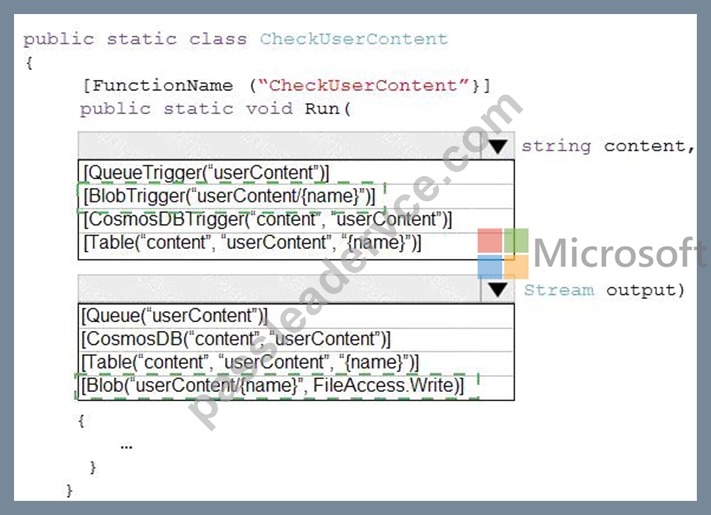
Explanation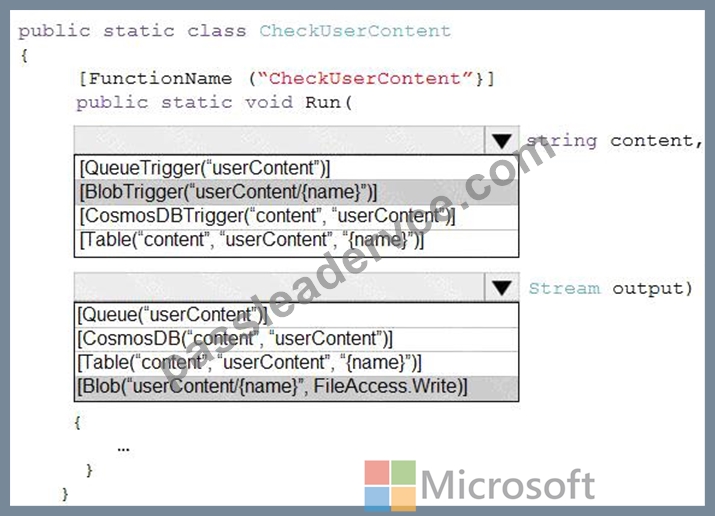
Box 1: [BlobTrigger(..)]
Box 2: [Blob(..)]
Azure Blob storage output binding for Azure Functions. The output binding allows you to modify and delete blob storage data in an Azure Function.
The attribute's constructor takes the path to the blob and a FileAccess parameter indicating read or write, as shown in the following example:
[FunctionName("ResizeImage")]
public static void Run(
[BlobTrigger("sample-images/{name}")] Stream image,
[Blob("sample-images-md/{name}", FileAccess.Write)] Stream imageSmall)
{
}
Scenario: You must create an Azure Function named CheckUserContent to perform the content checks.
The company's data science group built ContentAnalysisService which accepts user generated content as a string and returns a probable value for inappropriate content. Any values over a specific threshold must be reviewed by an employee of Contoso, Ltd.
Reference:
https://docs.microsoft.com/en-us/azure/azure-functions/functions-bindings-storage-blob-output
Topic 1, Contoso, Ltd
Case study
This is a case study.Case studies are not timed separately. You can use as much exam time as you would like to complete each case.However, there may be additional case studies and sections on this exam. You must manage your time to ensure that you are able to complete all questions included on this exam in the time provided.
To answer the questions included in a case study, you will need to reference information that is provided in the case study. Case studies might contain exhibits and other resources that provide more information about the scenario that is described in the case study. Each question is independent of the other questions in this case study.
At the end of this case study, a review screen will appear. This screen allows you to review your answers and to make changes before you move to the next section of the exam. After you begin a new section, you cannot return to this section.
To start the case study
To display the first question in this case study, click theNextbutton. Use the buttons in the left pane to explore the content of the case study before you answer the questions. Clicking these buttons displays information such as business requirements, existing environment, and problem statements. When you are ready to answer a question, click theQuestionbutton to return to the question.
Background
Overview
You are a developer for Contoso, Ltd. The company has a social networking website that is developed as a Single Page Application (SPA). The main web application for the social networking website loads user uploaded content from blob storage.
You are developing a solution to monitor uploaded data for inappropriate content. The following process occurs when users upload content by using the SPA:
* Messages are sent to ContentUploadService.
* Content is processed by ContentAnalysisService.
* After processing is complete, the content is posted to the social network or a rejection message is posted in its place.
The ContentAnalysisService is deployed with Azure Container Instances from a private Azure Container Registry named contosoimages.
The solution will use eight CPU cores.
Azure Active Directory
Contoso, Ltd. uses Azure Active Directory (Azure AD) for both internal and guest accounts.
Requirements
ContentAnalysisService
The company's data science group built ContentAnalysisService which accepts user generated content as a string and returns a probable value for inappropriate content. Any values over a specific threshold must be reviewed by an employee of Contoso, Ltd.
You must create an Azure Function named CheckUserContent to perform the content checks.
Costs
You must minimize costs for all Azure services.
Manual review
To review content, the user must authenticate to the website portion of the ContentAnalysisService using their Azure AD credentials. The website is built using React and all pages and API endpoints require authentication.
In order to review content a user must be part of a ContentReviewer role. All completed reviews must include the reviewer's email address for auditing purposes.
High availability
All services must run in multiple regions. The failure of any service in a region must not impact overall application availability.
Monitoring
An alert must be raised if the ContentUploadService uses more than 80 percent of available CPU cores.
Security
You have the following security requirements:
* Any web service accessible over the Internet must be protected from cross site scripting attacks.
* All websites and services must use SSL from a valid root certificate authority.
* Azure Storage access keys must only be stored in memory and must be available only to the service.
* All Internal services must only be accessible from internal Virtual Networks (VNets).
* All parts of the system must support inbound and outbound traffic restrictions.
* All service calls must be authenticated by using Azure AD.
User agreements
When a user submits content, they must agree to a user agreement. The agreement allows employees of Contoso, Ltd. to review content, store cookies on user devices, and track user's IP addresses.
Information regarding agreements is used by multiple divisions within Contoso, Ltd.
User responses must not be lost and must be available to all parties regardless of individual service uptime.
The volume of agreements is expected to be in the millions per hour.
Validation testing
When a new version of the ContentAnalysisService is available the previous seven days of content must be processed with the new version to verify that the new version does not significantly deviate from the old version.
Issues
Users of the ContentUploadService report that they occasionally see HTTP 502 responses on specific pages.
Code
ContentUploadService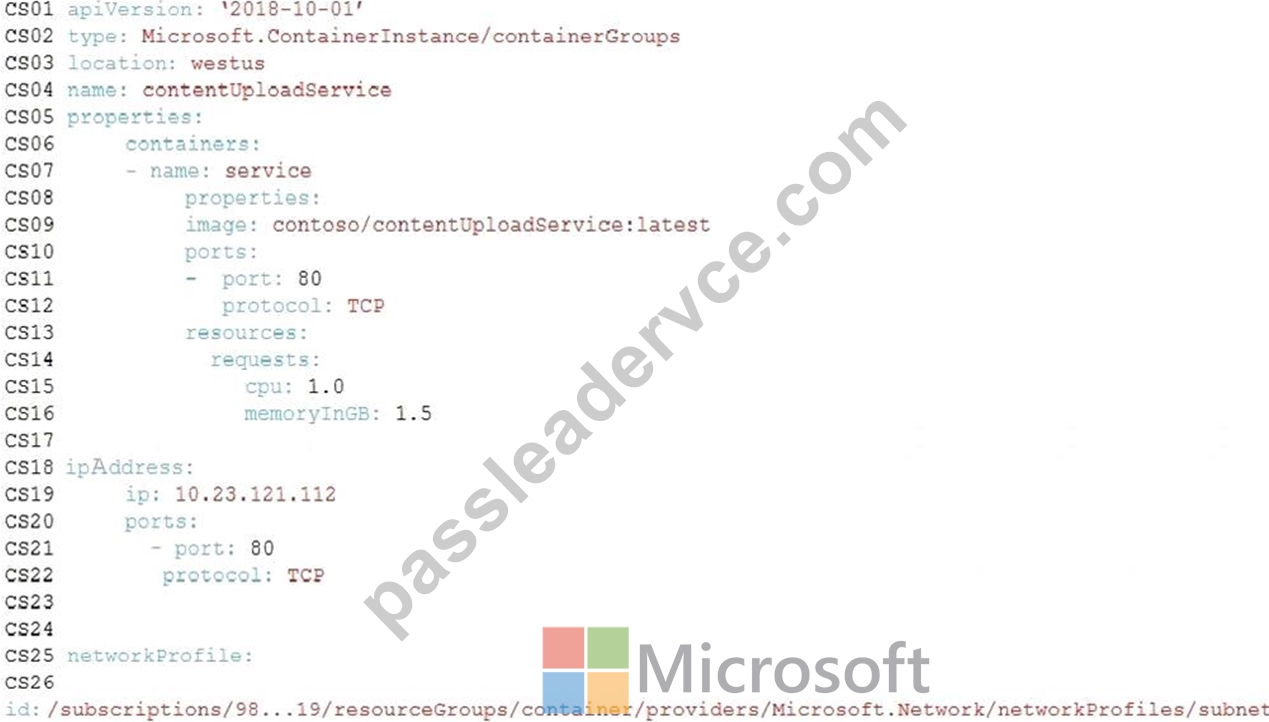
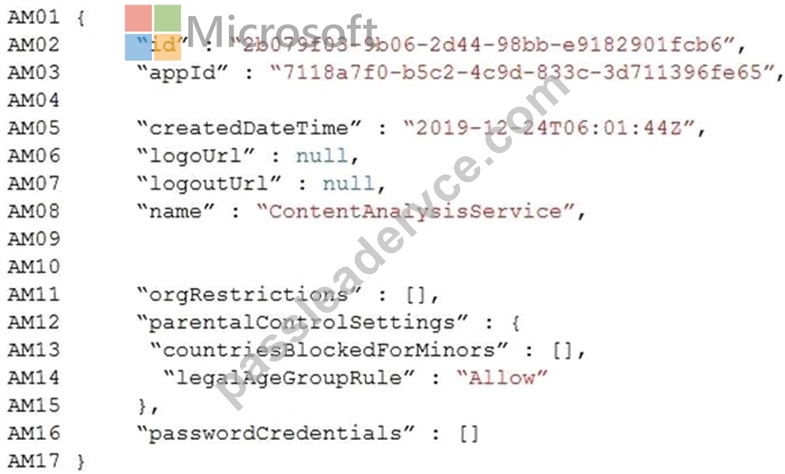
NEW QUESTION # 147
You need to ensure disaster recovery requirements are met.
What code should you add at line PC16?
To answer, drag the appropriate code fragments to the correct locations. Each code fragment may be used once, more than once, or not at all. You may need to drag the split bar between panes or scroll to view content.
NOTE: Each correct selection is worth one point.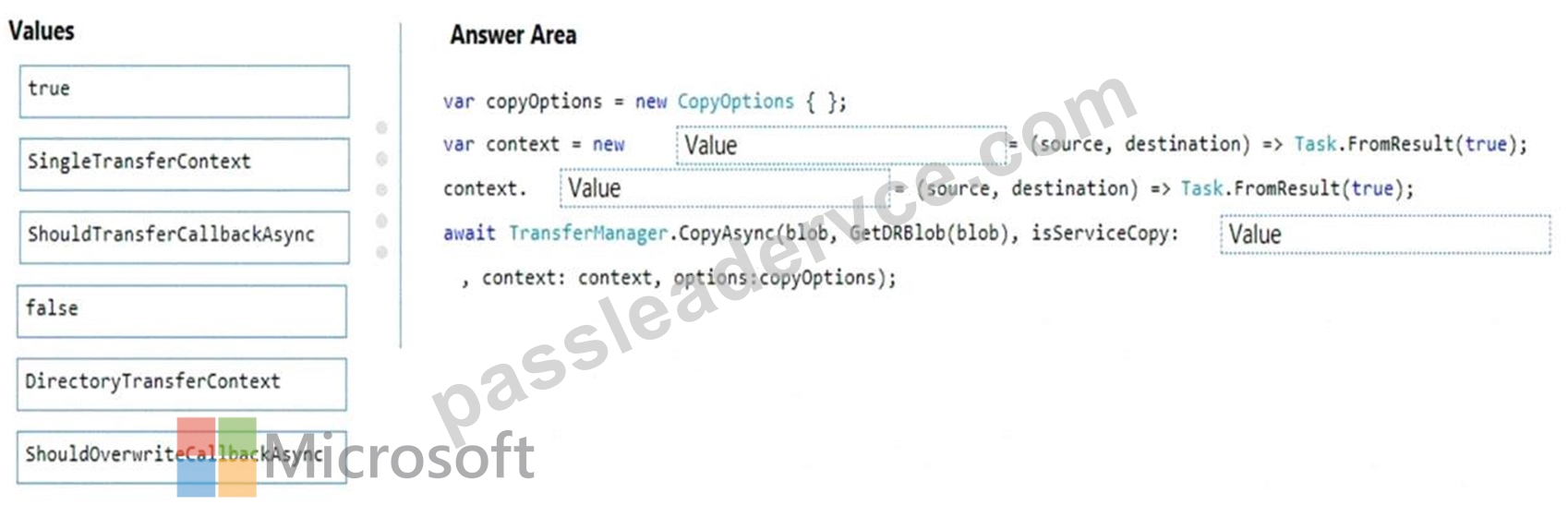
Answer:
Explanation: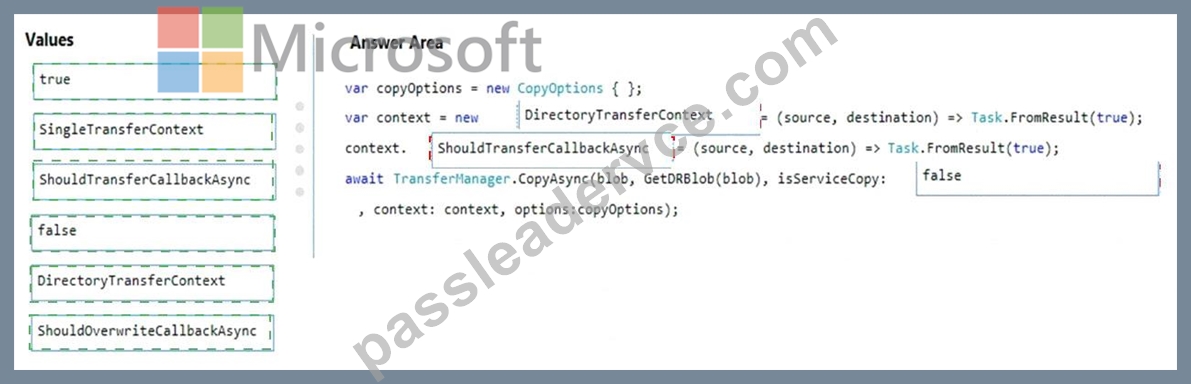
Explanation: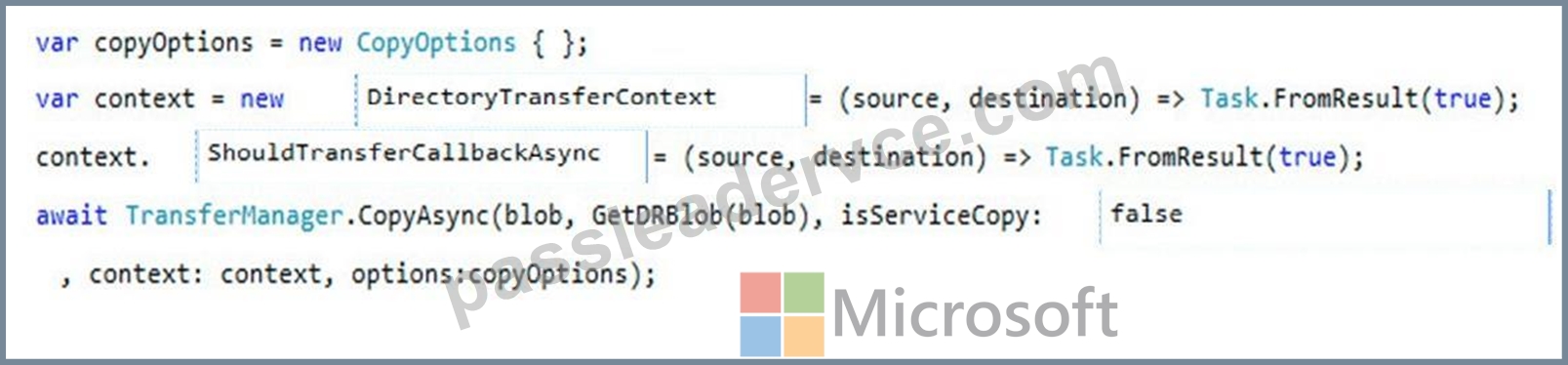
Scenario: Disaster recovery. Regional outage must not impact application availability. All DR operations must not be dependent on application running and must ensure that data in the DR region is up to date.
Box 1: DirectoryTransferContext
We transfer all files in the directory.
Note: The TransferContext object comes in two forms: SingleTransferContext and DirectoryTransferContext.
The former is for transferring a single file and the latter is for transferring a directory of files.
Box 2: ShouldTransferCallbackAsync
The DirectoryTransferContext.ShouldTransferCallbackAsync delegate callback is invoked to tell whether a transfer should be done.
Box 3: False
If you want to use the retry policy in Copy, and want the copy can be resume if break in the middle, you can use SyncCopy (isServiceCopy = false).
Note that if you choose to use service side copy ('isServiceCopy' set to true), Azure (currently) doesn't provide SLA for that. Setting 'isServiceCopy' to false will download the source blob loca Reference:
https://docs.microsoft.com/en-us/azure/storage/common/storage-use-data-movement-library
https://docs.microsoft.com/en-us/dotnet/api/microsoft.windowsazure.storage.datamovement.
directorytransfercontext.shouldtransfercallbackasync?view=azure-dotnet
NEW QUESTION # 148
You have a web app named MainApp. You are developing a triggered App Service background task by using the WebJobs SDK. This task automatically invokes a function code whenever any new data is received in a queue.
You need to configure the services.
Which service should you use for each scenario? To answer, drag the appropriate services to the correct scenarios. Each service may be used once, more than once, or not at all. You may need to drag the split bar between panes or scroll to view content.
NOTE: Each correct selection is worth one point.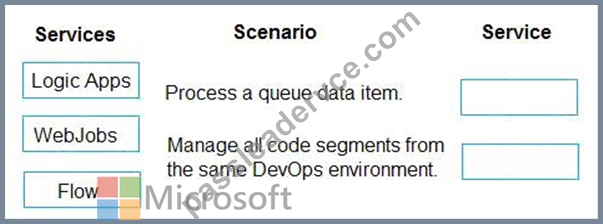
Answer:
Explanation: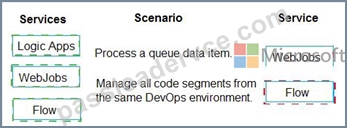
Explanation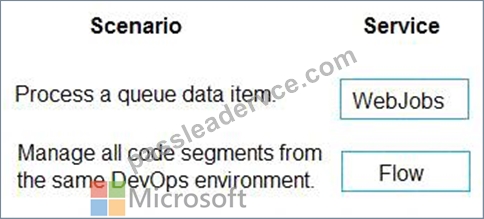
Box 1: WebJobs
A WebJob is a simple way to set up a background job, which can process continuously or on a schedule.
WebJobs differ from a cloud service as it gives you get less fine-grained control over your processing environment, making it a more true PaaS service.
Box 2: Flow
NEW QUESTION # 149
You are building a website to access project data related to terms within your organization. The website does not allow anonymous access. Authentication performed using an Azure Active Directory (Azure AD) app named internal.
The website has the following authentication requirements:
*Azure AD users must be able to login to the website.
*Personalization of the website must be based on membership in Active Directory groups.
You need to configure the application's manifest to meet the authentication requirements.
How should you configure the manifest? To answer, select the appropriate options in the answer area.
NOTE: Each correct selection is worth one point.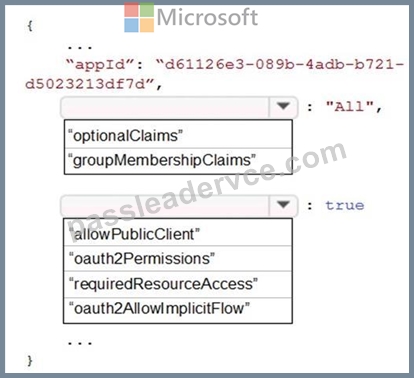
Answer:
Explanation: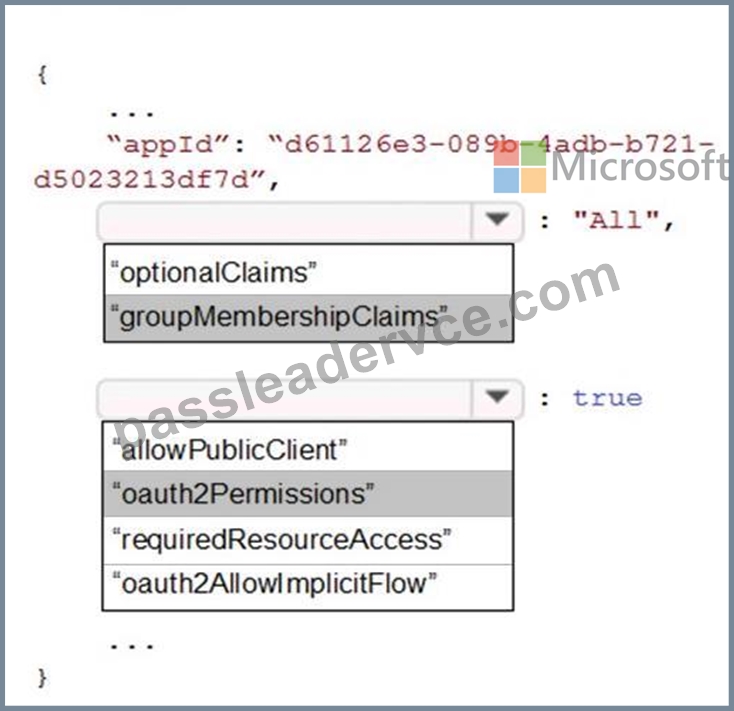
Box 1: groupMembershipClaims
Scenario: Personalization of the website must be based on membership in Active Directory groups.
Group claims can also be configured in the Optional Claims section of the Application Manifest.
Enable group membership claims by changing the groupMembershipClaim
The valid values are:
"All"
"SecurityGroup"
"DistributionList"
"DirectoryRole"
Box 2: oauth2Permissions
Scenario: Azure AD users must be able to login to the website.
oauth2Permissions specifies the collection of OAuth 2.0 permission scopes that the web API (resource) app exposes to client apps. These permission scopes may be granted to client apps during consent.
NEW QUESTION # 150
You are developing an app that manages users for a video game. You plan to store the region, email address, and phone number for the player. Some players may not have a phone number. The player's region will be used to load-balance data.
Data for the app must be stored in Azure Table Storage.
You need to develop code to retrieve data for an individual player.
How should you complete the code? To answer, select the appropriate options in the answer area.
NOTE: Each correct selection is worth one point.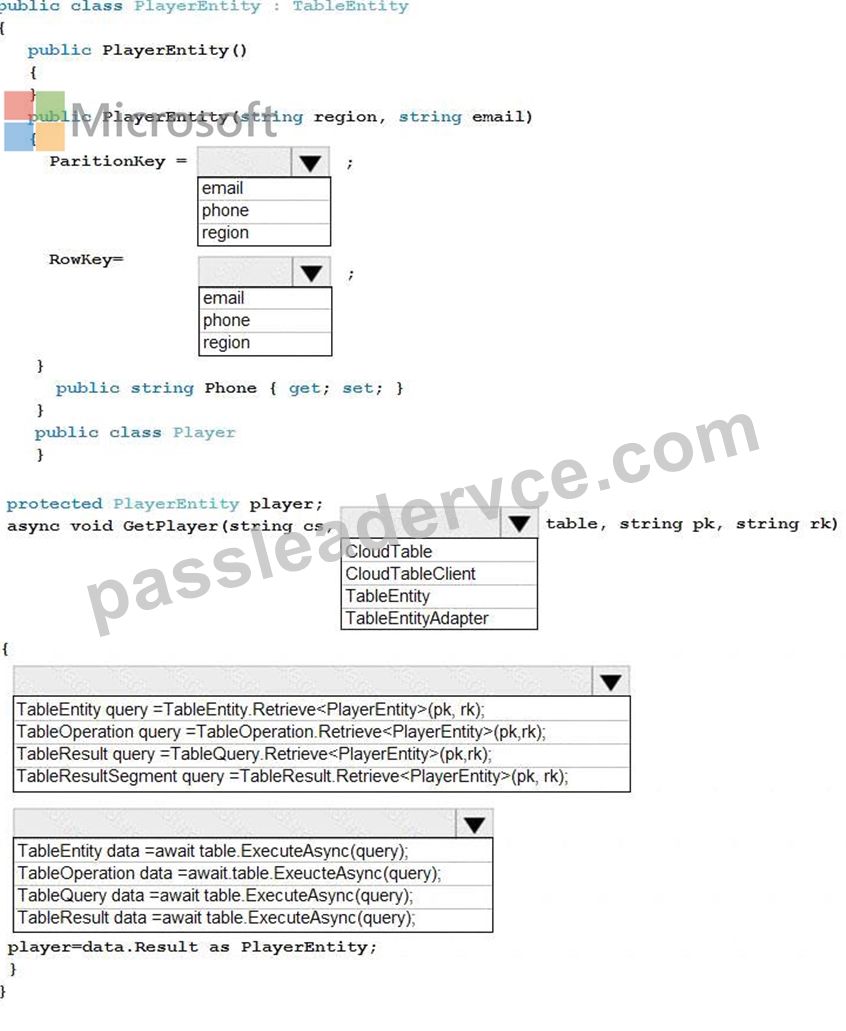
Answer:
Explanation: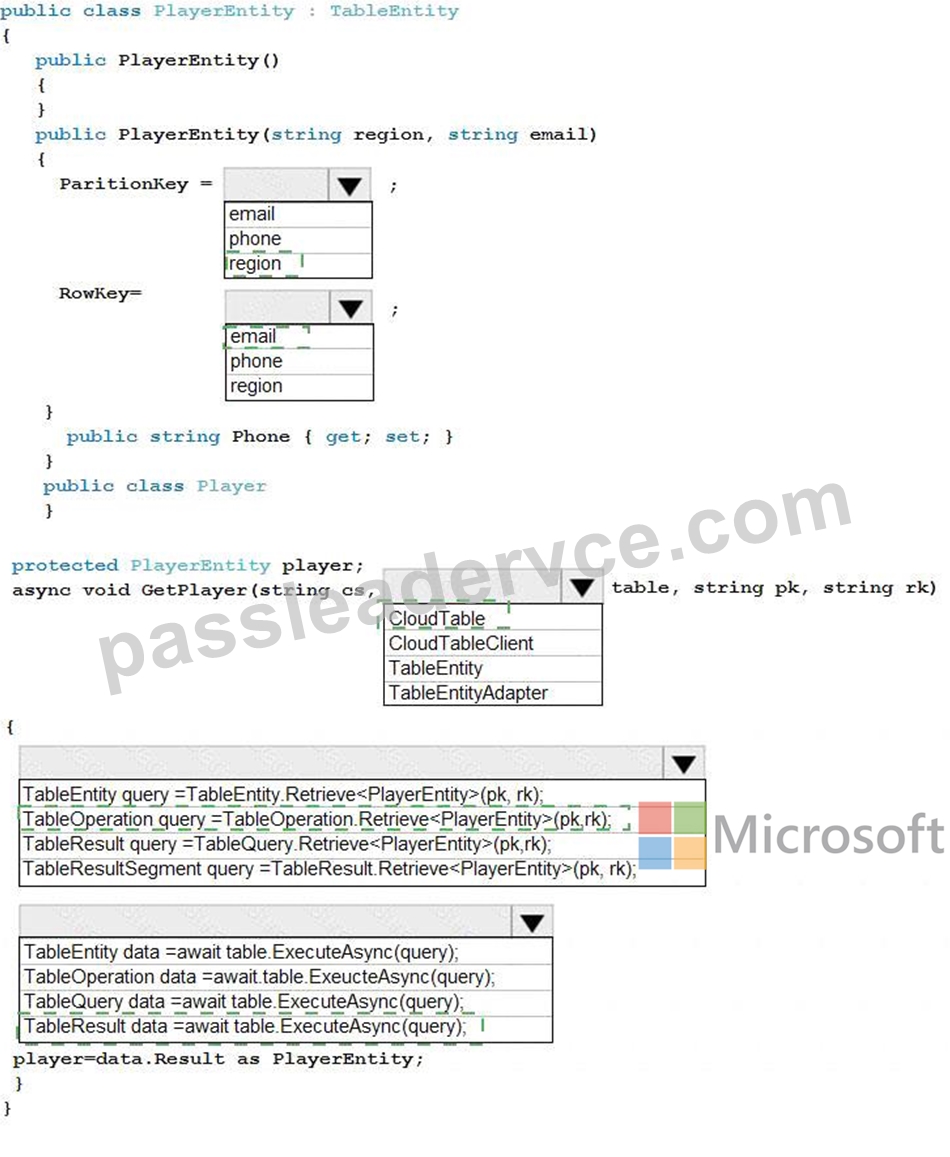
Explanation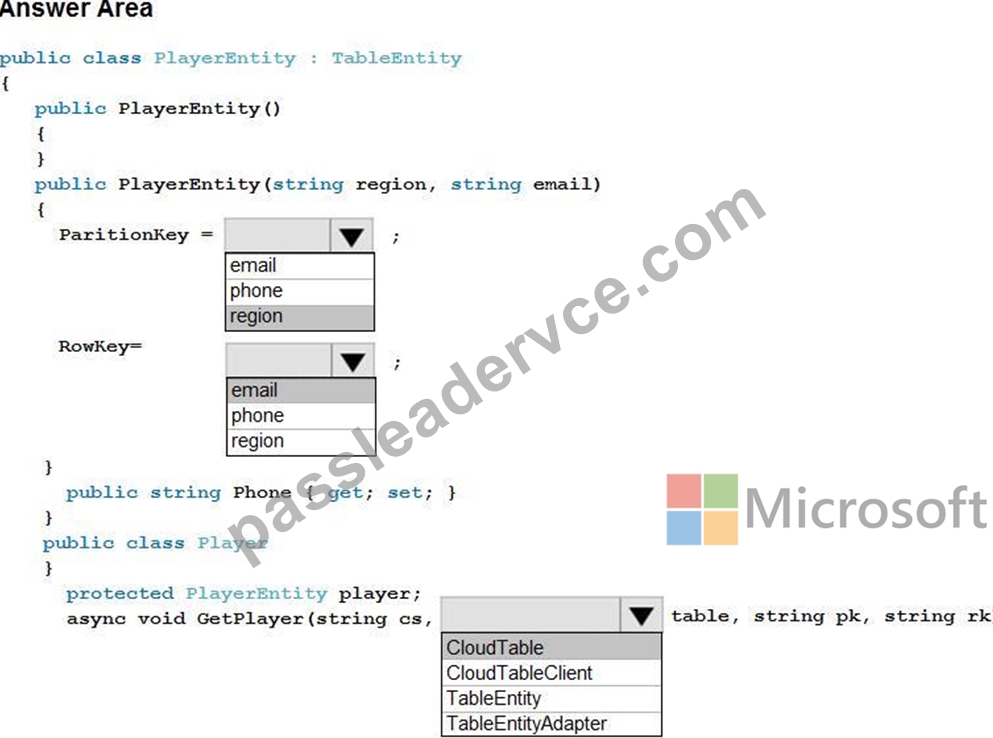
Explanation: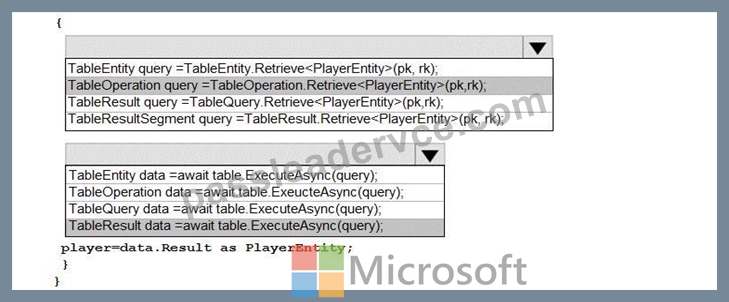
Box 1: region
The player's region will be used to load-balance data.
Choosing the PartitionKey.
The core of any table's design is based on its scalability, the queries used to access it, and storage operation requirements. The PartitionKey values you choose will dictate how a table will be partitioned and the type of queries that can be used. Storage operations, in particular inserts, can also affect your choice of PartitionKey values.
Box 2: email
Not phone number some players may not have a phone number.
Box 3: CloudTable
Box 4 : TableOperation query =..
Box 5: TableResult
References:
https://docs.microsoft.com/en-us/rest/api/storageservices/designing-a-scalable-partitioning-strategy-for-azure-tab
NEW QUESTION # 151
You develop an Azure solution that uses Cosmos DB.
The current Cosmos DB container must be replicated and must use a partition key that is optimized for queries.
You need to implement a change feed processor solution.
Which change feed processor components should you use? To answer, drag the appropriate components to the correct requirements. Each component may be used once, more than once, or not at all. You may need to drag the split bar between panes or scroll to view the content.
NOTE: Each correct selection is worth one point.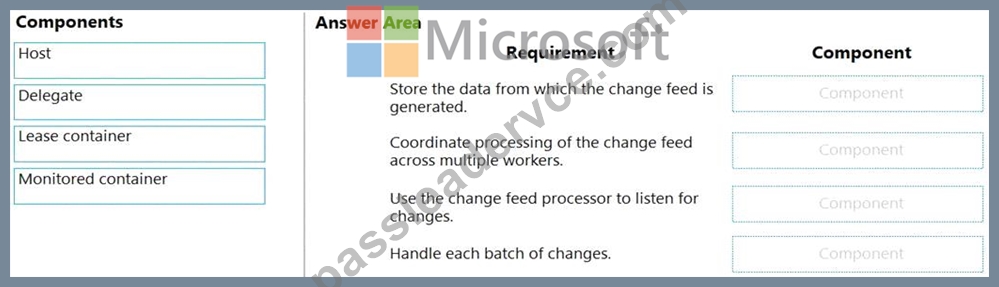
Answer:
Explanation: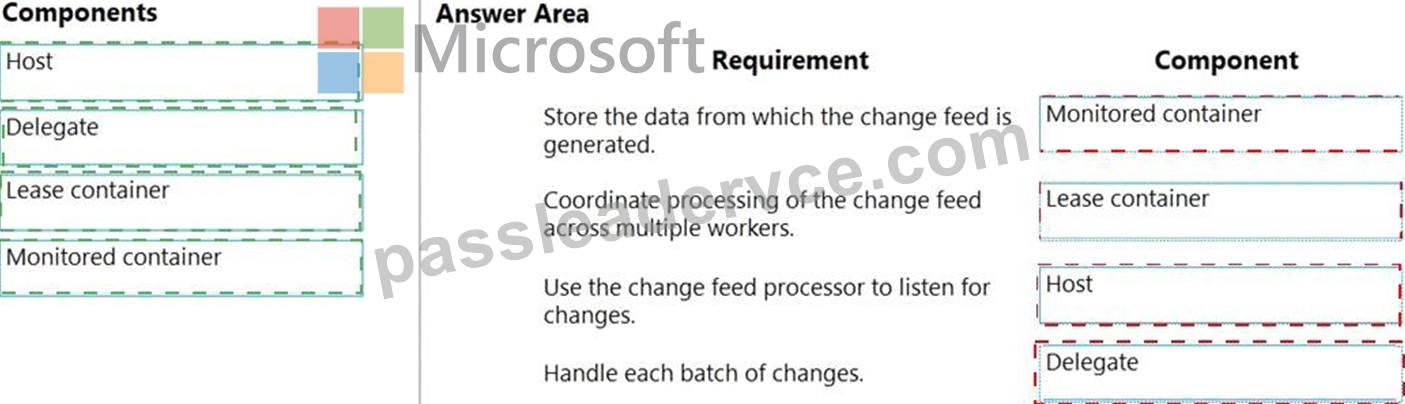
Explanation
Graphical user interface, application Description automatically generated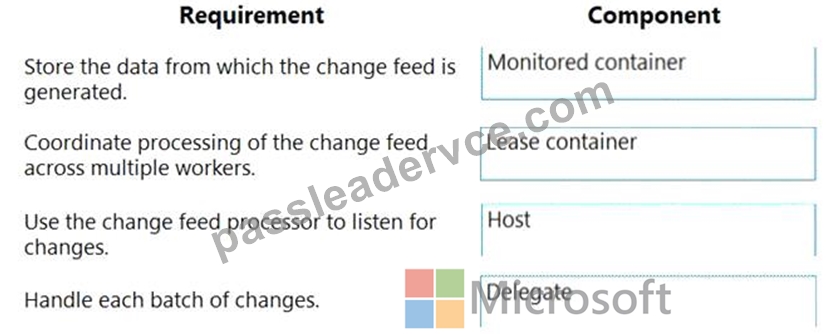
Box 1: The monitored container
The monitored container has the data from which the change feed is generated. Any inserts and updates to the monitored container are reflected in the change feed of the container.
Box 2: The lease container
The lease container acts as a state storage and coordinates processing the change feed across multiple workers.
The lease container can be stored in the same account as the monitored container or in a separate account.
Box 3: The host: A host is an application instance that uses the change feed processor to listen for changes.
Multiple instances with the same lease configuration can run in parallel, but each instance should have a different instance name.
Box 4: The delegate
The delegate is the code that defines what you, the developer, want to do with each batch of changes that the change feed processor reads.
Reference:
https://docs.microsoft.com/en-us/azure/cosmos-db/change-feed-processor
NEW QUESTION # 152
Contoso, Ltd. provides an API to customers by using Azure API Management (APIM). The API authorizes users with a JWT token.
You must implement response caching for the APIM gateway. The caching mechanism must detect the user ID of the client that accesses data for a given location and cache the response for that user ID.
You need to add the following policies to the policies file:
* a set-variable policy to store the detected user identity
* a cache-lookup-value policy
* a cache-store-value policy
* a find-and-replace policy to update the response body with the user profile information To which policy section should you add the policies? To answer, drag the appropriate sections to the correct policies. Each section may be used once, more than once, or not at all. You may need to drag the split bar between panes or scroll to view content NOTE: Each correct selection is worth one point
Answer:
Explanation:
Explanation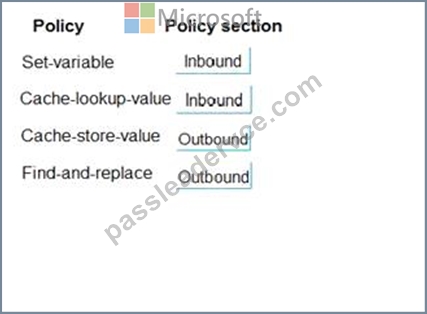
Box 1: Inbound.
A set-variable policy to store the detected user identity.
Example:
<policies>
<inbound>
<!-- How you determine user identity is application dependent -->
<set-variable
name="enduserid"
value="@(context.Request.Headers.GetValueOrDefault("Authorization","").Split(' ')[1].AsJwt()?.Subject)" /> Box 2: Inbound A cache-lookup-value policy Example:
<inbound>
<base />
<cache-lookup vary-by-developer="true | false" vary-by-developer-groups="true | false" downstream-caching-type="none | private | public" must-revalidate="true | false">
<vary-by-query-parameter>parameter name</vary-by-query-parameter> <!-- optional, can repeated several times -->
</cache-lookup>
</inbound>
Box 3: Outbound
A cache-store-value policy.
Example:
<outbound>
<base />
<cache-store duration="3600" />
</outbound>
Box 4: Outbound
A find-and-replace policy to update the response body with the user profile information.
Example:
<outbound>
<!-- Update response body with user profile-->
<find-and-replace
from='"$userprofile$"'
to="@((string)context.Variables["userprofile"])" />
<base />
</outbound>
Reference:
https://docs.microsoft.com/en-us/azure/api-management/api-management-caching-policies
https://docs.microsoft.com/en-us/azure/api-management/api-management-sample-cache-by-key
NEW QUESTION # 153
You need to configure Azure CDN for the Shipping web site.
Which configuration options should you use? To answer, select the appropriate options in the answer area.
NOTE: Each correct selection is worth one point.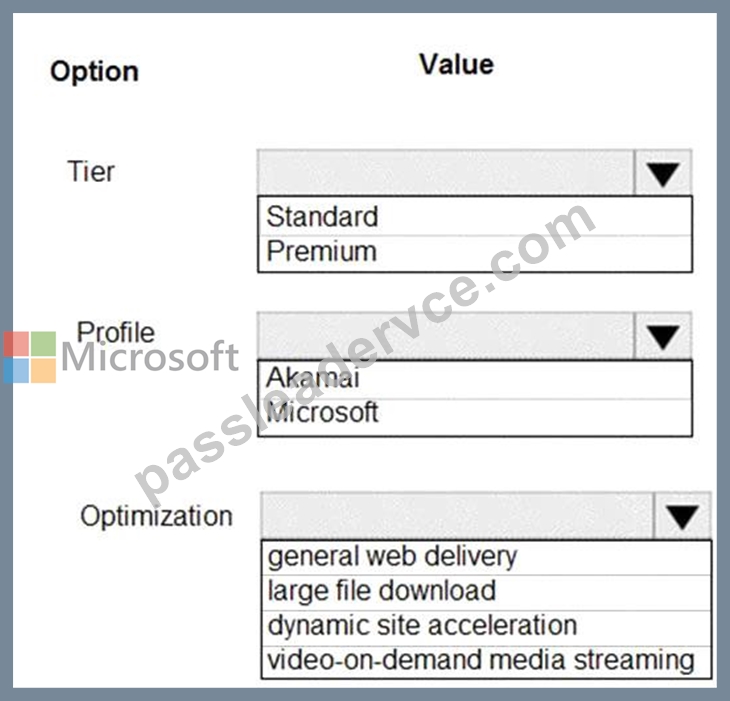
Answer:
Explanation: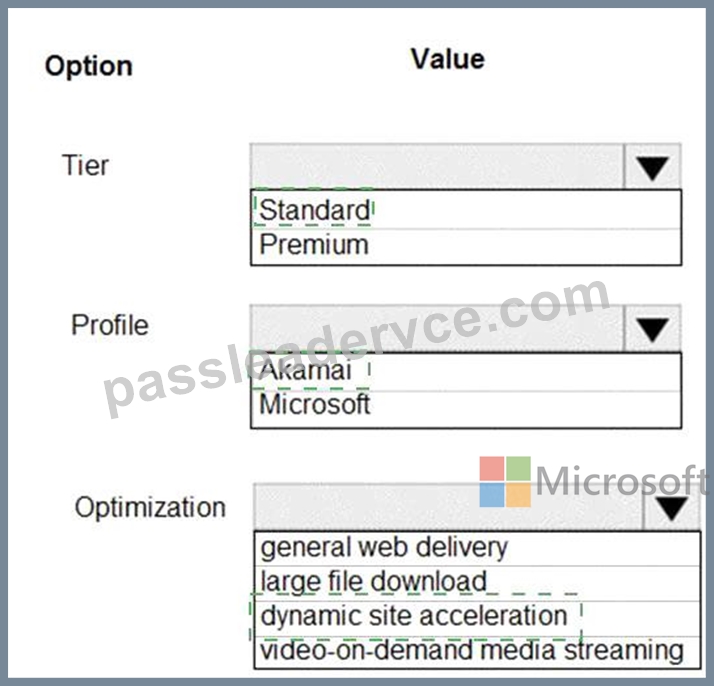
Explanation: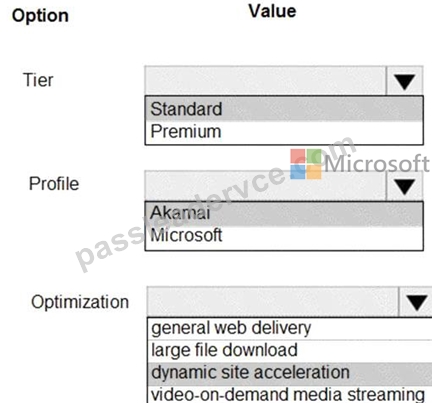
Scenario: Shipping website
Use Azure Content Delivery Network (CDN) and ensure maximum performance for dynamic content while minimizing latency and costs.
Tier: Standard
Profile: Akamai
Optimization: Dynamic site acceleration
Dynamic site acceleration (DSA) is available for Azure CDN Standard from Akamai, Azure CDN Standard from Verizon, and Azure CDN Premium from Verizon profiles.
DSA includes various techniques that benefit the latency and performance of dynamic content. Techniques include route and network optimization, TCP optimization, and more.
You can use this optimization to accelerate a web app that includes numerous responses that aren't cacheable.
Examples are search results, checkout transactions, or real-time data. You can continue to use core Azure CDN caching capabilities for static data.
Reference:
https://docs.microsoft.com/en-us/azure/cdn/cdn-optimization-overview
NEW QUESTION # 154
You are debugging an application that is running on Azure Kubernetes cluster named cluster1. The cluster uses Azure Monitor for containers to monitor the cluster.
The application has sticky sessions enabled on the ingress controller.
Some customers report a large number of errors in the application over the last 24 hours.
You need to determine on which virtual machines (VMs) the errors are occurring.
How should you complete the Azure Monitor query? To answer, select the appropriate options in the answer area.
NOTE: Each correct selection is worth one point.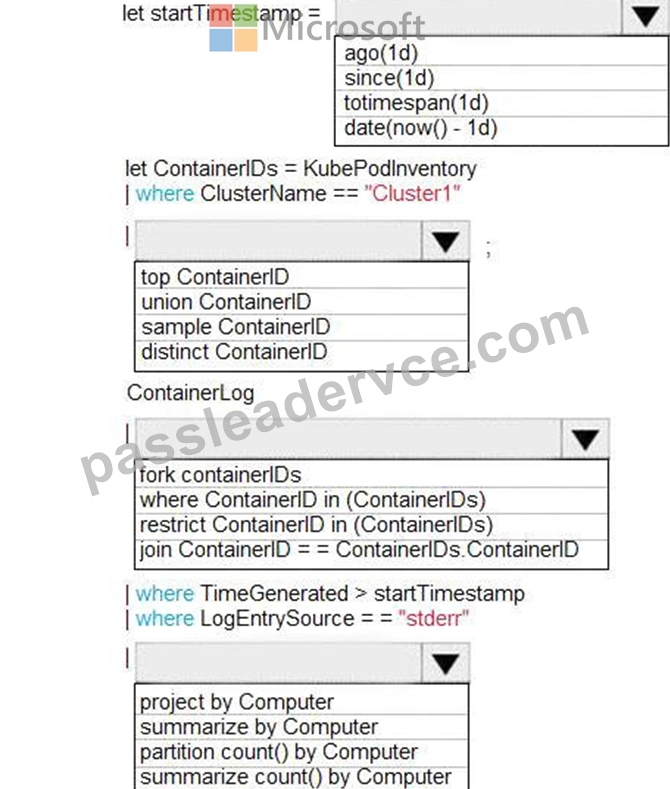
Answer:
Explanation: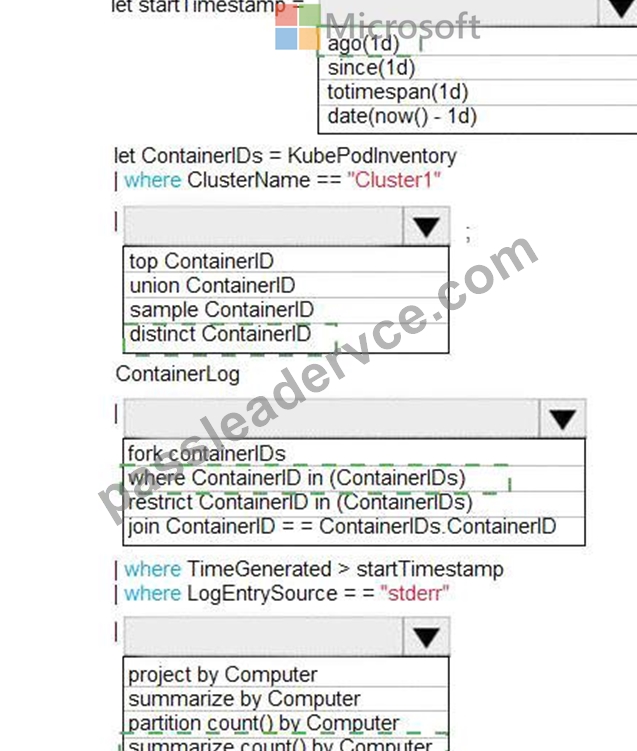
Explanation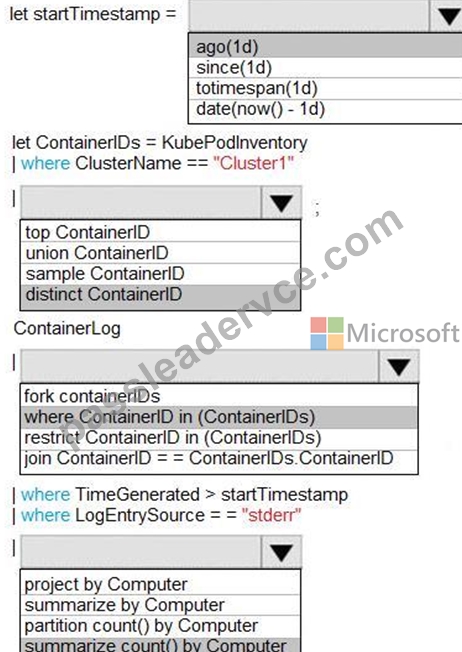
Box 1: ago(1d)
Box 2: distinct containerID
Box 3: where ContainerID in (ContainerIDs)
Box 4: summarize Count by Computer
Summarize: aggregate groups of rows
Use summarize to identify groups of records, according to one or more columns, and apply aggregations to them. The most common use of summarize is count, which returns the number of results in each group.
Reference:
https://docs.microsoft.com/en-us/azure/azure-monitor/log-query/get-started-queries
https://docs.microsoft.com/en-us/azure/azure-monitor/log-query/query-optimization
NEW QUESTION # 155
You need to secure the Shipping Function app.
How should you configure the app? To answer, select the appropriate options in the answer area.
NOTE: Each correct selection is worth one point.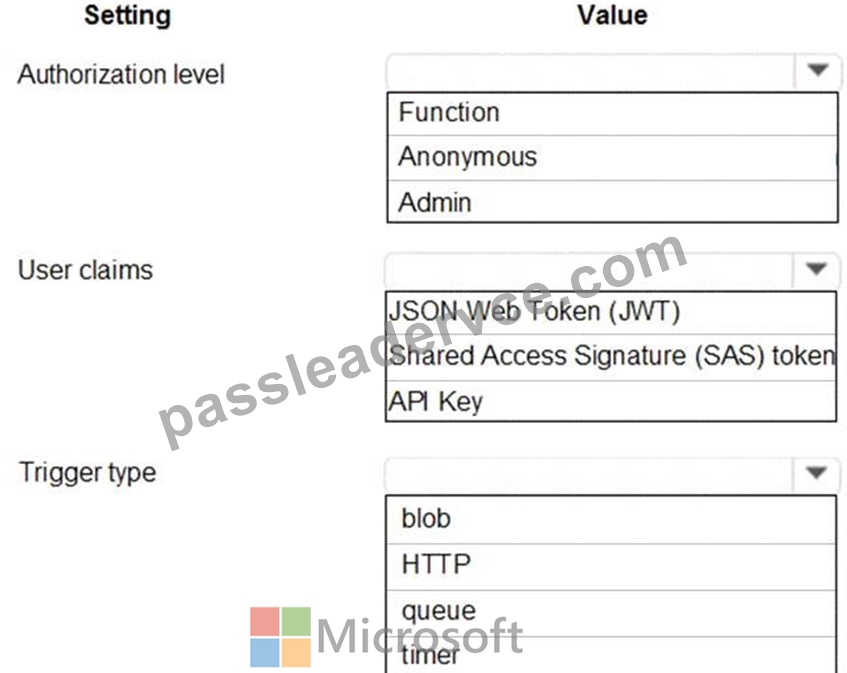
Answer:
Explanation: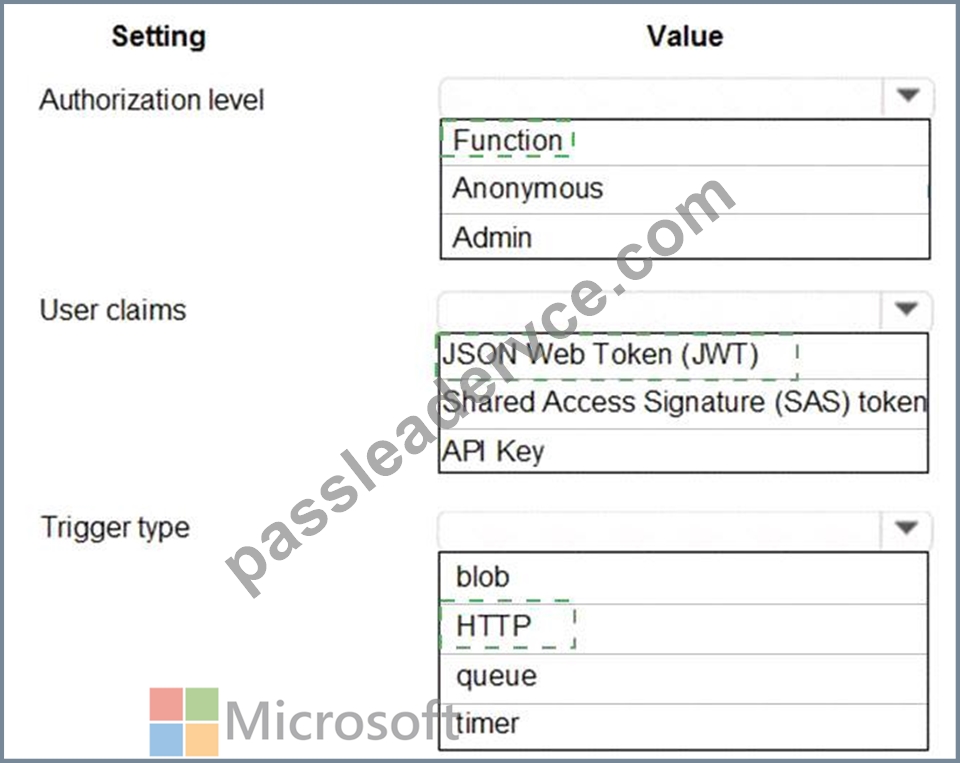
Explanation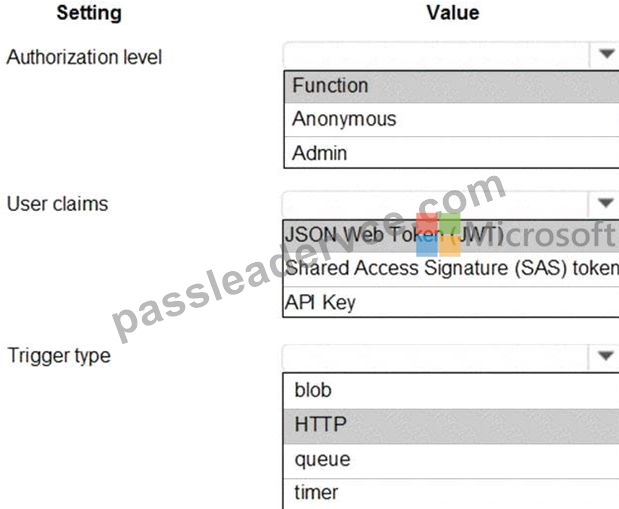
Scenario: Shipping Function app: Implement secure function endpoints by using app-level security and include Azure Active Directory (Azure AD).
Box 1: Function
Box 2: JSON based Token (JWT)
Azure AD uses JSON based tokens (JWTs) that contain claims
Box 3: HTTP
How a web app delegates sign-in to Azure AD and obtains a token
User authentication happens via the browser. The OpenID protocol uses standard HTTP protocol messages.
References:
https://docs.microsoft.com/en-us/azure/active-directory/develop/authentication-scenarios
NEW QUESTION # 156
Contoso, Ltd. provides an API to customers by using Azure API Management (APIM). The API authorizes users with a JWT token.
You must implement response caching for the APIM gateway. The caching mechanism must detect the user ID of the client that accesses data for a given location and cache the response for that user ID.
You need to add the following policies to the policies file:
* a set-variable policy to store the detected user identity
* a cache-lookup-value policy
* a cache-store-value policy
* a find-and-replace policy to update the response body with the user profile information
To which policy section should you add the policies? To answer, drag the appropriate sections to the correct policies. Each section may be used once, more than once, or not at all. You may need to drag the split bar between panes or scroll to view content
NOTE: Each correct selection is worth one point
Answer:
Explanation:
Reference:
https://docs.microsoft.com/en-us/azure/api-management/api-management-caching-policies
https://docs.microsoft.com/en-us/azure/api-management/api-management-sample-cache-by-key
NEW QUESTION # 157
You have an Azure Web app that uses Cosmos DB as a data store. You create a CosmosDB container by running the following PowerShell script:
$resourceGroupName = "testResourceGroup"
$accountName = "testCosmosAccount"
$databaseName = "testDatabase"
$containerName = "testContainer"
$partitionKeyPath = "/EmployeeId"
$autoscaleMaxThroughput = 5000
New-AzCosmosDBSqlContainer
-ResourceGroupName $resourceGroupName
-AccountName $accountName
-DatabaseName $databaseName
-Name $containerName
-PartitionKeyKind Hash
-PartitionKeyPath $partitionKeyPath
-AutoscaleMaxThroughput $autoscaleMaxThroughput
You create the following queries that target the container:
SELECT * FROM c WHERE c.EmployeeId > '12345'
SELECT * FROM c WHERE c.UserID = '12345'
For each of the following statements, select Yes if the statement is true. Otherwise, select No.
NOTE: Each correct selection is worth one point.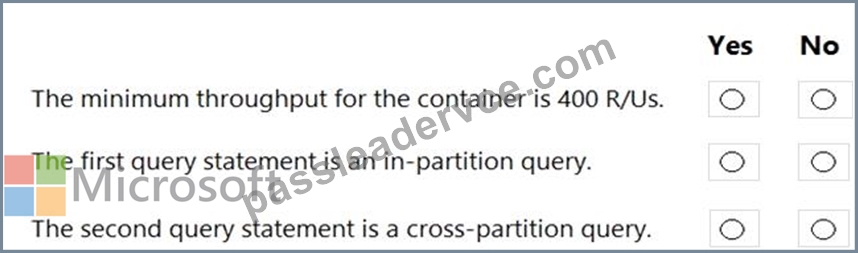
Answer:
Explanation: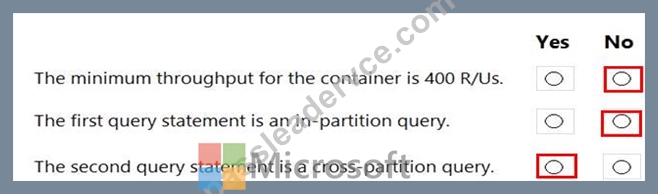
Reference:
https://docs.microsoft.com/en-us/azure/cosmos-db/how-to-choose-offer
https://docs.microsoft.com/en-us/azure/cosmos-db/how-to-query-container
NEW QUESTION # 158
You plan to deploy a new application to a Linux virtual machine (VM) that is hosted in Azure.
The entire VM must be secured at rest by using industry-standard encryption technology to address organizational security and compliance requirements.
You need to configure Azure Disk Encryption for the VM.
How should you complete the Azure Cli commands? To answer, select the appropriate options in the answer area.
NOTE: Each correct selection is worth one point.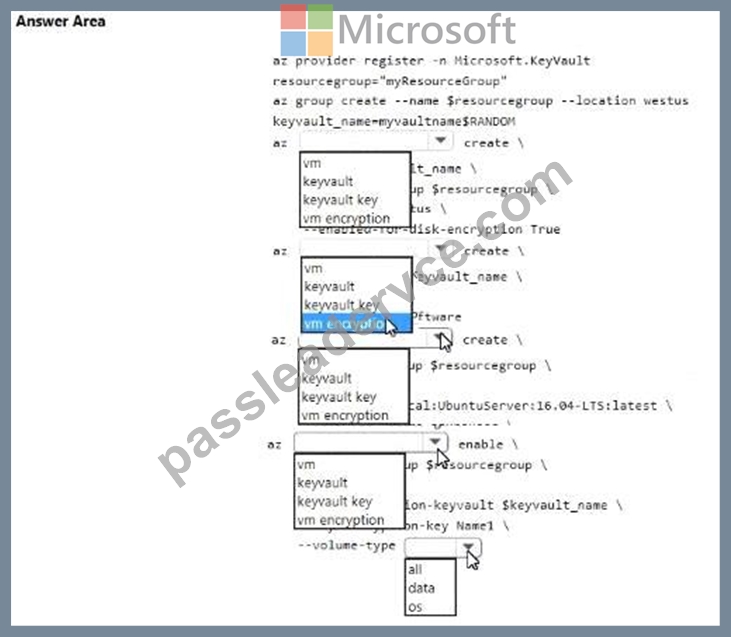
Answer:
Explanation: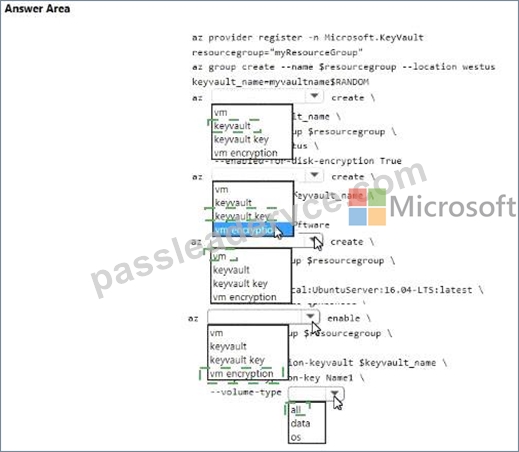
Explanation: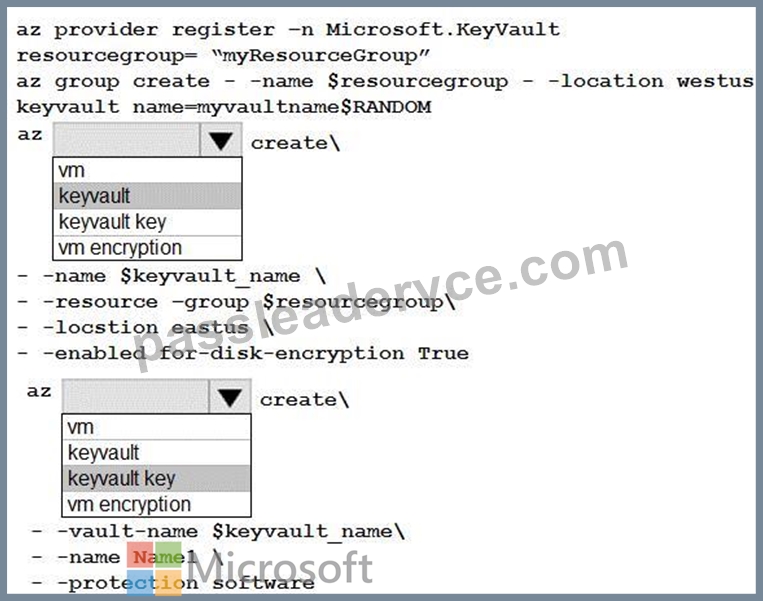
Box 1: keyvault
Create an Azure Key Vault with az keyvault create and enable the Key Vault for use with disk encryption.
Specify a unique Key Vault name for keyvault_name as follows:
keyvault_name=myvaultname$RANDOM
az keyvault create \
--name $keyvault_name \
--resource-group $resourcegroup \
--location eastus \
--enabled-for-disk-encryption True
Box 2: keyvault key
The Azure platform needs to be granted access to request the cryptographic keys when the VM boots to decrypt the virtual disks. Create a cryptographic key in your Key Vault with az keyvault key create. The following example creates a key named myKey:
az keyvault key create \
--vault-name $keyvault_name \
--name myKey \
--protection software
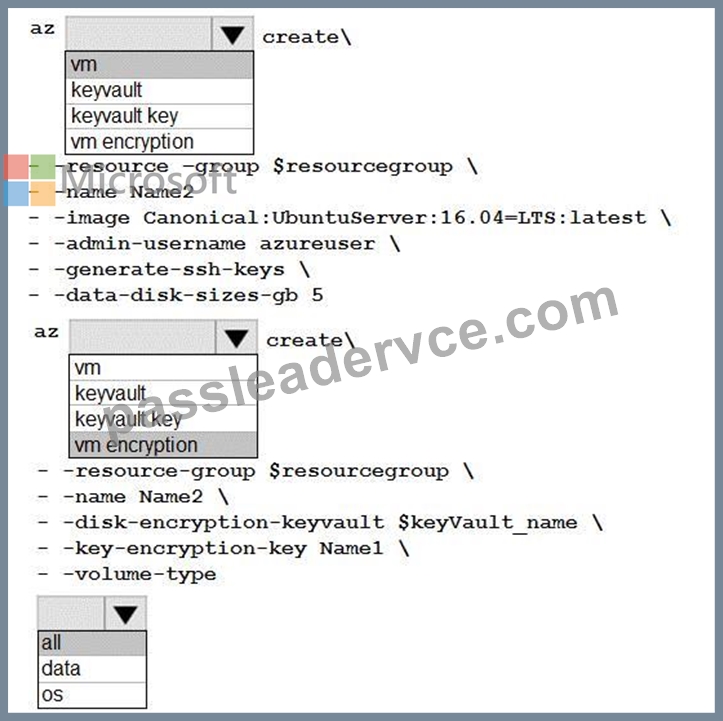
Box 3: vm
Create a VM with az vm create. Only certain marketplace images support disk encryption. The following example creates a VM named myVM using an Ubuntu 16.04 LTS image:
az vm create \
--resource-group $resourcegroup \
--name myVM \
--image Canonical:UbuntuServer:16.04-LTS:latest \
--admin-username azureuser \
--generate-ssh-keys \
Box 4: vm encryption
Encrypt your VM with az vm encryption enable:
az vm encryption enable \
--resource-group $resourcegroup \
--name myVM \
--disk-encryption-keyvault $keyvault_name \
--key-encryption-key myKey \
--volume-type all
Note: seems to an error in the question. Should have enable instead of create.
Box 5: all
Encrypt both data and operating system.
References:
https://docs.microsoft.com/bs-latn-ba/azure/virtual-machines/linux/encrypt-disks
NEW QUESTION # 159
You plan to deploy a web app to App Service on Linux. You create an App Service plan. You create and push a custom Docker image that image that contains the web app to Azure Container Registry.
You need to access the console logs generated from inside the container in real-time.
How should you complete the Azure CLI command? To answer, select the appropriate options in the answer area.
NOTE: Each correct selection is worth one point.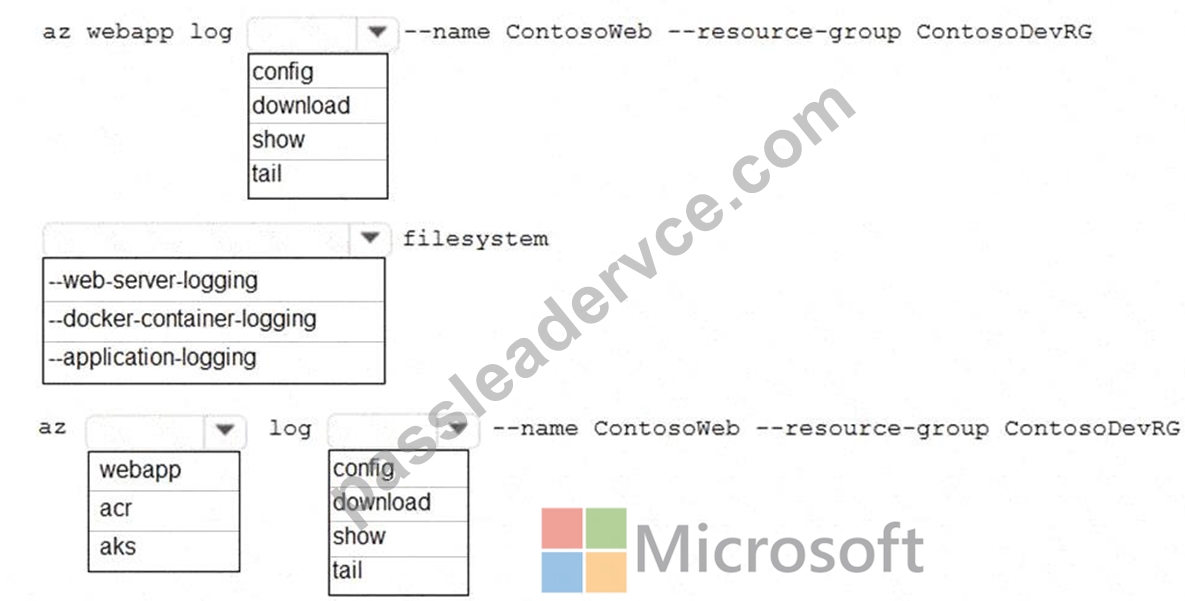
Answer:
Explanation: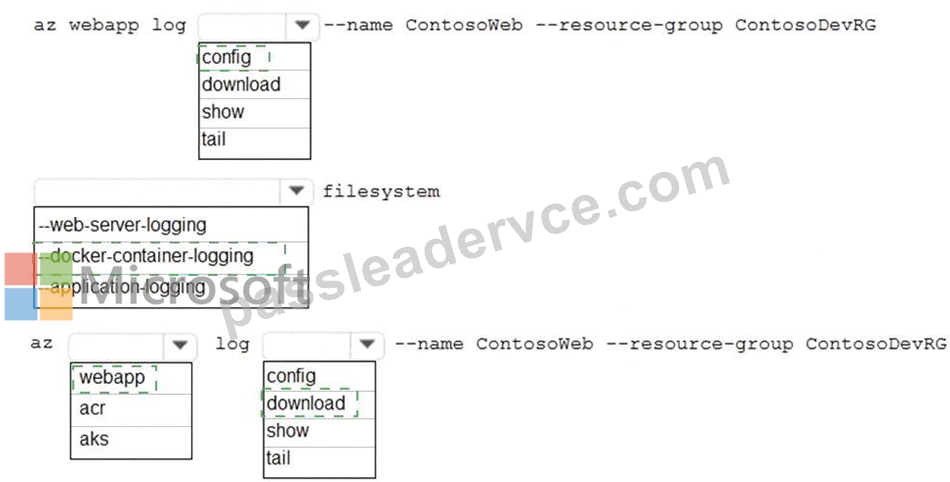
Explanation: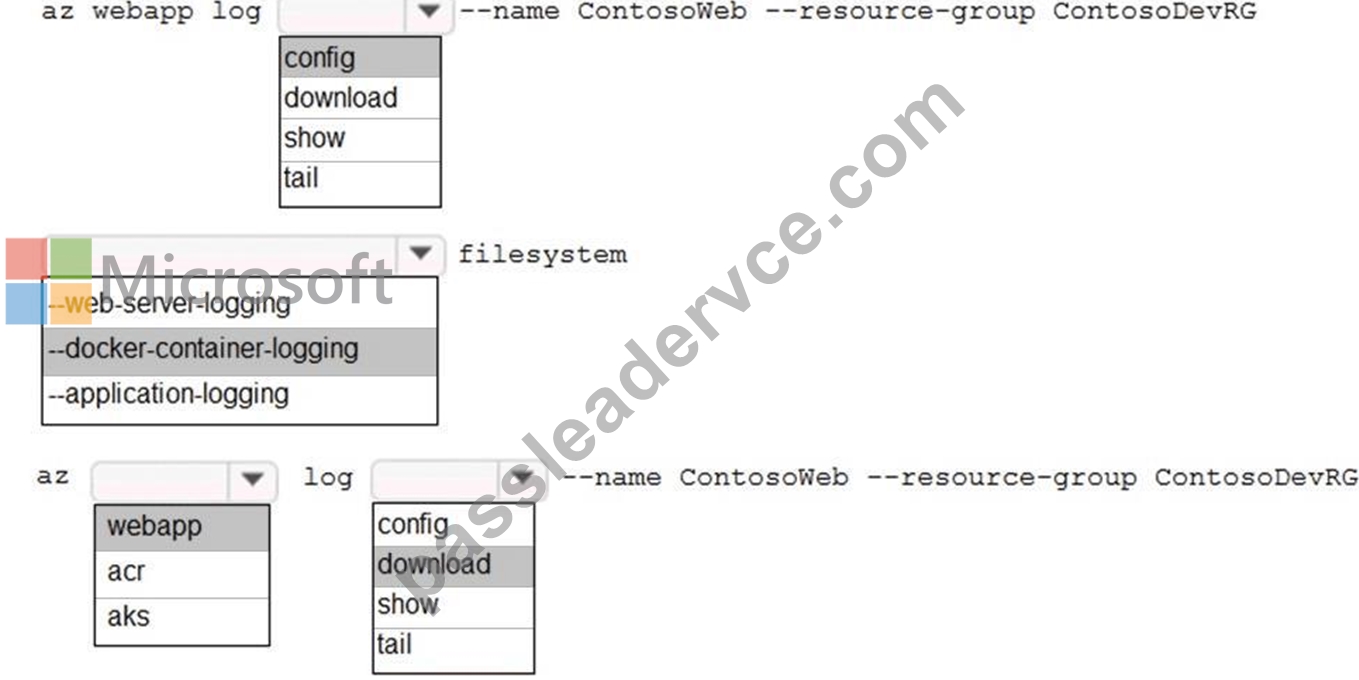
Box 1: config
To Configure logging for a web app use the command:
az webapp log config
Box 2: --docker-container-logging
Syntax include:
az webapp log config [--docker-container-logging {filesystem, off}]
Box 3: webapp
To download a web app's log history as a zip file use the command:
az webapp log download
Box 4: download
References:
https://docs.microsoft.com/en-us/cli/azure/webapp/log
NEW QUESTION # 160
Your company is migrating applications to Azure. The IT department must allow internal developers to communicate with Microsoft support.
The service agents of the IT department must only have view resources and create support ticket permissions to all subscriptions. A new custom role must be created by reusing a default role definition and changing the permissions.
You need to create the custom role.
To answer, select the appropriate options in the answer area.
NOTE: Each correct selection is worth one point.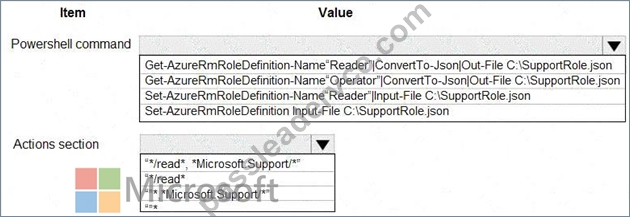
Answer:
Explanation: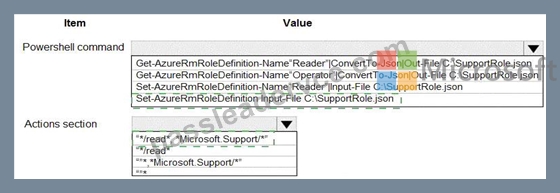
Explanation: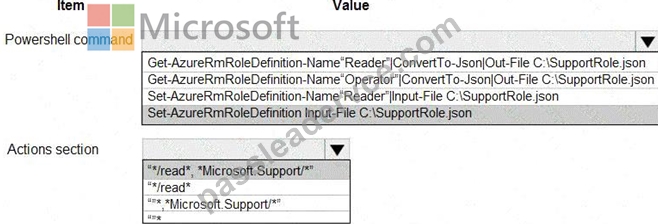
Box 1: Set-AzureRmRoleDefinition Input-File C:\SupportRole.json
The Set-AzureRmRoleDefinition cmdlet updates an existing custom role in Azure Role-Based Access Control. Provide the updated role definition as an input to the command as a JSON file or a PSRoleDefinition object.
The role definition for the updated custom role MUST contain the Id and all other required properties of the role even if they are not updated: DisplayName, Description, Actions, AssignableScope Box 2: "*/read*."* Microsoft.Support/*" Microsoft.Support/* Create and manage support tickets
"Microsoft.Support" role definition azure
NEW QUESTION # 161
......
The AZ-204 exam is a great way for developers to showcase their expertise in Azure development. Achieving this certification can help them stand out in the job market and increase their earning potential. Developing Solutions for Microsoft Azure certification also demonstrates a commitment to continuous learning and growth, which is highly valued in the technology industry.
AZ-204 dumps Free Test Engine Verified By It Certified Experts: https://pass4itsure.passleadervce.com/Microsoft-Azure/reliable-AZ-204-exam-learning-guide.html