

Jan-2026 Realistic 2V0-12.24 Exam Dumps with Accurate & Updated Questions
2V0-12.24 Exam Dumps - PDF Questions and Testing Engine
NEW QUESTION # 55
An Administrator is configuring the network within their VCF management domain in preparation to deploy VMware Aria Suite Lifecycle.
What are the two types of virtual networks that the Administrator could configure to support the deployment? (Choose two.)
- A. VLAN-backed Port Groups
- B. Overlay-backed NSX Segments
- C. VXLAN-backed Network Pools
- D. VLAN-backed NSX Segments
Answer: A,B
Explanation:
VLAN-backed Port Groups are used in traditional network environments where VLANs are configured on the physical switches. These port groups can be configured in the management domain to support network connectivity.
Overlay-backed NSX Segments use NSX to create virtual networks overlaid on existing physical networks, which is essential for network virtualization and communication between virtual machines, especially in a VMware Cloud Foundation environment.
NEW QUESTION # 56
An administrator is tasked with deploying a new application that requires both virtual machines and containers.
Which two components of VMware Cloud Foundation would be utilized to provide a unified platform for managing these workloads? (Choose two.)
- A. Aria Suite Lifecycle
- B. IaaS Control Plane
- C. Aria Operations
- D. HCX
- E. NSX
Answer: C,E
Explanation:
Aria Operations: Aria Operations (formerly vRealize Operations) provides a unified platform for managing both virtual machines (VMs) and containers, offering monitoring, analytics, and performance management for the entire environment.
NSX: NSX provides network virtualization and security, which can be used to manage network traffic for both VMs and containers, offering a consistent networking model for both workloads.
NEW QUESTION # 57
Which three tasks are performed by Cloud Builder during the bring-up process of a VMware Cloud Foundation solution? (Choose three.)
- A. vCenter and NSX Manager cluster deployment
- B. Aria Suite Lifecycle Manager deployment
- C. SDDC manager deployment
- D. vVols storage configuration for all management hosts
- E. NSX Edge cluster deployment
- F. vSphere HA/DRS cluster creation and configuration
Answer: A,C,E
Explanation:
Cloud Builder deploys the SDDC Manager, which is responsible for managing and automating the VMware Cloud Foundation environment.
Cloud Builder deploys the NSX Edge cluster as part of the network configuration during the bring-up process.
Cloud Builder also deploys the vCenter and NSX Manager clusters to ensure proper management and network virtualization for the VMware Cloud Foundation environment.
NEW QUESTION # 58
An administrator needs to ensure that network traffic is protected from interception and tampering during VM migration activities. What feature or setting should the administrator enable to achieve this?
- A. Encrypted vSphere vMotion
- B. vSphere DRS
- C. vSphere HA
- D. vSphere Virtual Machine Encryption
Answer: A
Explanation:
Encrypted vSphere vMotion ensures that network traffic is protected from interception and tampering during VM migration activities by encrypting the vMotion traffic. This feature secures the transfer of virtual machines across hosts in the vSphere environment.
NEW QUESTION # 59
An administrator has a requirement to share the contents of a Content Library across multiple vCenter instances.
What steps should the administrator perform to meet this requirement?
- A. Create a Local content library on each vCenter instance and perform a synchronization
- B. Create a Subscribed content library on each vCenter instance and enable publishing
- C. Create a Local content library on a single vCenter instance and enable publishing
- D. Create a Subscribed content library on a single vCenter instance and perform a synchronization
Answer: C
Explanation:
To share the contents of a Content Library across multiple vCenter instances, you need to create a Local content library on one vCenter instance and enable publishing. This allows the library to be accessible by other vCenter instances, where they can subscribe to it, ensuring the content is shared.
NEW QUESTION # 60
What is the primary purpose of configuring VM storage policies in a VMware vSphere environment?
- A. To enforce specific storage requirements such as performance, availability, and redundancy.
- B. To automate the backup of virtual machines.
- C. To configure CPU and memory reservations for VMs.
- D. To manage network traffic between VMs.
Answer: A
Explanation:
The primary purpose of configuring VM storage policies in a VMware vSphere environment is to enforce specific storage requirements such as performance, availability, and redundancy. These policies help ensure that virtual machines are placed on datastores that meet the desired service levels and characteristics.
NEW QUESTION # 61
An administrator needs to add a new cluster to an existing VI workload domain. The existing cluster in the domain is using NFS as its principal storage.
Which principal storage options are available for the new cluster?
- A. vSAN, NFS, VMFS on Fibre Channel, or vVols
- B. NFS or vSAN
- C. NFS only
- D. vSAN, NFS, or VMFS on Fibre Channel
Answer: B
Explanation:
In a VMware Cloud Foundation (VCF) environment, when adding a new cluster to an existing VI workload domain, the new cluster must use the same principal storage as the existing cluster. Since the existing cluster is using NFS, the available storage options for the new cluster would be NFS or vSAN, depending on the configuration.
NEW QUESTION # 62
An administrator needs to ensure that their VMware Cloud Foundation-based private cloud solution can support multi-tenancy for different departments within their organization.
What two configurations and components are necessary to achieve this? (Choose two.)
- A. Use vSphere Resource Pools to allocate resources to different departments.
- B. Deploy Aria Automation to enable self-service provisioning for tenants.
- C. Use NSX to create isolated network segments for each tenant.
- D. Configure vSAN storage policies for each department.
Answer: A,C
Explanation:
vSphere Resource Pools allow for the allocation of CPU, memory, and storage resources to different departments (tenants) within the VMware Cloud Foundation environment. This ensures that each department has its own dedicated resources, preventing resource contention between them.
NSX can be used to create isolated network segments (logical networks) for each tenant, ensuring network security and segmentation between departments. Each department can have its own isolated network environment.
NEW QUESTION # 63
An administrator is tasked with enabling Workload Management (vSphere IaaS control plane) on a VMware Cloud Foundation workload domain.
Which three of the following are prerequisites for enabling Workload Management? (Choose three.)
- A. Configure NTP and DNS settings for all management components.
- B. Install the vSphere Client on all ESXi hosts.
- C. Verify that all ESXi hosts are running vSphere 7.0 or later.
- D. Ensure that the cluster has at least three ESXi hosts.
Answer: A,C,D
Explanation:
For Workload Management in VMware Cloud Foundation, a minimum of three ESXi hosts is required to create a robust, highly available vSphere cluster.
Proper NTP and DNS configuration is essential to ensure time synchronization and proper resolution of network names, which are critical for Workload Management.
The hosts must be running vSphere 7.0 or later to be compatible with the latest features and requirements for Workload Management.
NEW QUESTION # 64
When configuring a new port group on a Virtual Distributed Switch (VDS), what is the purpose of setting a VLAN ID?
- A. To automate the creation of VMs within the port group.
- B. To enable load balancing across multiple uplinks.
- C. To manage storage replication settings
- D. To segment and isolate network traffic.
Answer: D
Explanation:
Setting a VLAN ID on a port group on a Virtual Distributed Switch (VDS) allows for network segmentation by tagging traffic with the appropriate VLAN ID. This enables isolation of network traffic between different VLANs, ensuring that communication is restricted to specific segments of the network as required.
NEW QUESTION # 65
An administrator needs to secure an ESXi host in their environment by enabling lockdown mode.
What two steps should be taken to secure the ESXi host using lockdown mode? (Choose two.)
- A. Enable "Strict Lockdown Mode" to restrict all direct access to the host.
- B. Navigate to the host's settings in the vSphere Client.
- C. Add the host to a dedicated security group in Active Directory.
- D. Disable SSH and the ESXi Shell.
- E. Reboot the host to apply the lockdown settings.
Answer: A,B
Explanation:
To enable lockdown mode, you first need to navigate to the ESXi host's settings in the vSphere Client, where you can configure security settings such as lockdown mode.
Enabling "Strict Lockdown Mode" restricts all direct access to the ESXi host, ensuring that only authorized users can manage the host through vCenter and preventing direct login via the ESXi console or SSH.
NEW QUESTION # 66
Put the following steps in the correct order to update the driver/firmware in vSAN.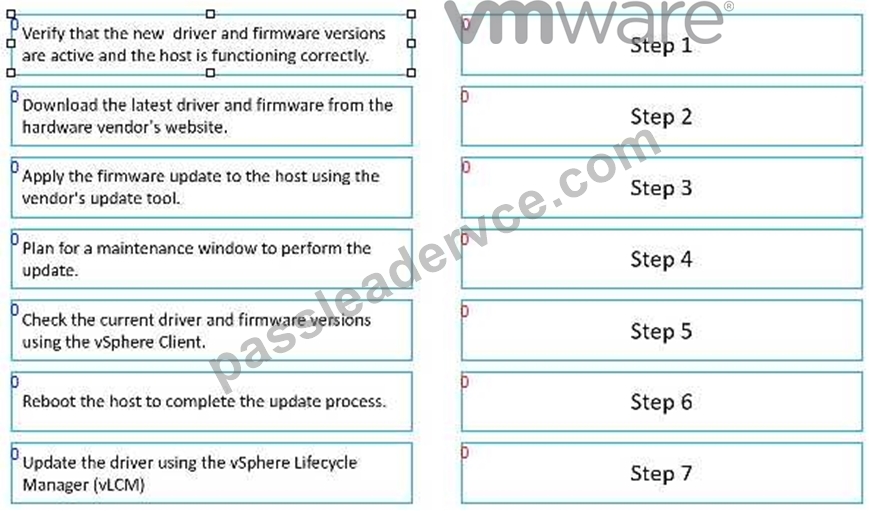
Answer:
Explanation: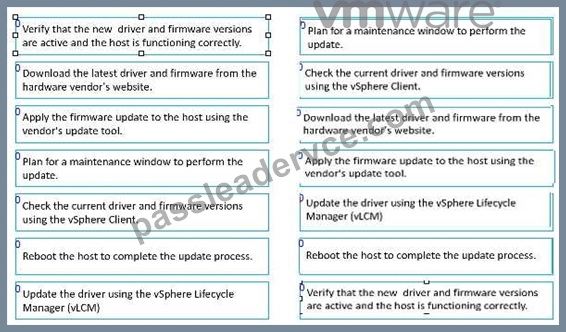
NEW QUESTION # 67
An organization is implementing a downtime avoidance solution and wants to ensure continuous availability of applications across separate sites that are connected via a high bandwidth/low latency link.
Which two VMware Cloud Foundation components support this capability with stretched clusters? (Choose two.)
- A. vSphere Replication
- B. NSX Firewall
- C. vVOL
- D. vSAN
- E. vSphere
Answer: D,E
Explanation:
vSAN: vSAN supports stretched clusters, allowing data to be mirrored across multiple sites to ensure continuous availability and enable high availability for virtual machines in case of a site failure.
vSphere: vSphere also supports stretched clusters, enabling the high availability of applications across multiple sites by allowing virtual machines to be run on either site in the event of a failure.
NEW QUESTION # 68
What is the primary benefit of using VMware vCenter Content Libraries?
- A. They provide enhanced security for vCenter Server.
- B. They allow for the automation of VM snapshots.
- C. They enable centralized management and distribution of VM templates, ISO images, and scripts.
- D. They facilitate the creation of virtual networks.
Answer: C
Explanation:
VMware vCenter Content Libraries provide a centralized location for storing and managing virtual machine templates, ISO images, and scripts, making it easier to distribute these resources across multiple vCenter instances. This helps streamline the deployment process, ensuring consistency and reducing the overhead of managing these resources manually.
NEW QUESTION # 69
Match the vSAN troubleshooting tasks with their corresponding tools.
A) Resolving disk failures
B) Updating vSAN drivers
C) Checking vSAN health
D) Recovering from a controller failure
1) Use the ESXCLI tool
2) Use the vSAN health plugin in vSphere Client
3) Use the hardware diagnostics tool
4) Use the Skyline Health Insights
Response:
- A. A-2, B-1, C-3, D-4
- B. A-3, B-1, C-2, D-4
- C. A-2, B-3, C-4, D-1
- D. A-4, B-1, C-3, D-2
Answer: B
NEW QUESTION # 70
An administrator has been tasked with expanding an existing VMware Cloud Foundation environment by adding a new workload domain. The environment currently has one management domain and one VI workload domain.
What options are available to the administrator for deploying NSX in the second VI workload domain?
- A. The new workload domain can have its own dedicated NSX Fabric or it can join the existing NSX Fabric configured in the existing VI domain.
- B. The new workload domain can have a dedicated NSX Fabric or it can join the existing NSX Fabric configured in either the management domain or existing VI domain.
- C. The new workload domain must have a dedicated NSX Fabric.
- D. The new workload domain can have its own dedicated NSX Fabric or it can join the existing NSX Fabric configured in the management domain.
Answer: B
Explanation:
When expanding a VMware Cloud Foundation environment with a new workload domain, you have the flexibility to either configure a dedicated NSX Fabric for the new domain or join an existing NSX Fabric from either the management domain or a previously established VI workload domain. This allows for consistent and scalable network virtualization across multiple domains in the environment.
NEW QUESTION # 71
An organization needs to perform maintenance on a specific host in a vSAN cluster. An administrator is required to put the host into maintenance mode whilst ensuring that all VMs in the cluster remain accessible.
Which three steps should the administrator take to correctly set a vSAN host into maintenance mode? (Choose three.)
- A. Migrate all VMs manually from the host before enabling maintenance mode.
- B. Right-click the host and select "Enter Maintenance Mode."
- C. Navigate to the vSAN cluster in the vSphere Client and select the host.
- D. Choose the "Ensure Accessibility" option to maintain data accessibility.
- E. Select the "No Data Migration" option to speed up the process.
Answer: B,C,D
Explanation:
The "Ensure Accessibility" option ensures that all data remains accessible during maintenance while minimizing the impact on performance and data migration.
The administrator must navigate to the vSAN cluster in the vSphere Client to select the host for maintenance mode.
Right-clicking the host and selecting "Enter Maintenance Mode" is the standard action for placing a host into maintenance mode.
NEW QUESTION # 72
While deploying the first VI workload domain in a VMware Cloud Foundation solution, which two steps will always be performed by SDDC Manager? (Choose two.)
- A. Deploy a new NSX Manaqer instance for the VI workload domain.
- B. Confiqure vSAN for the VI workload domain's storaqe needs.
- C. Deploy and confiqure a newvCenter Server instance for the VI workload domain.
- D. Connect a newvCenter Server instance to the Application Virtual Network.
- E. Deploy an NSX Edqe cluster and confiqure BGP routinq on the TO Gateway.
Answer: A,C
Explanation:
SDDC Manager automatically deploys and configures a new vCenter Server instance as part of the deployment of the VI workload domain.
SDDC Manager also handles the deployment of a new NSX Manager instance to provide network virtualization services for the VI workload domain.
NEW QUESTION # 73
......
Pass VMware 2V0-12.24 Exam Quickly With PassLeaderVCE: https://pass4itsure.passleadervce.com/VMware-Professional/reliable-2V0-12.24-exam-learning-guide.html