

Qlik Exam 2023 QSDA2022 Dumps Updated Questions UPDATED Apr-2023
Get The Most Updated QSDA2022 Dumps To Qlik Sense Data Architect Certification
NEW QUESTION # 20
Refer to the exhibit.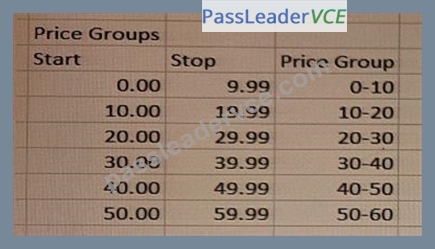
A data architect must classify each product into a price group. The price groups must be the same width by default and allow users to dynamically change the width of the bucket duringanalysis.
Which feature should the data architect use to meet these requirements?
- A. IntervalMatch and use variables
- B. Class function in a calculated dimension
- C. Nested IFs in a calculated dimension
- D. Class function in the script and use variables
Answer: B
NEW QUESTION # 21 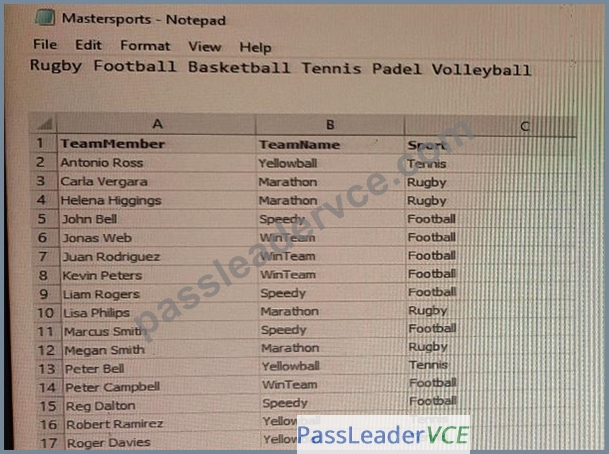
Refer to the exhibits.
The first table, Mastersports, contains the master list of all sport names that need to be loaded into the app. The second table, TeamMembers, containsthe teams and team members registered for specific sports.
In a Qlik Sense app, a data architect is loading the two tables that need to be linked together based on the Sport field. The table format cannot be changed in the source.
What should the dataarchitect do in the data load editor?
- A. Apply a preceding LOAD from the TeamMembers table with the SUBFIELD function and rename the field to Sport
- B. Apply a preceding LOAD to the MasterSports table with the SUBFIELD function to create the Sport field
- C. Apply a FOR loop to load to the MasterSports table creating the values for the Sport field
Answer: C
NEW QUESTION # 22 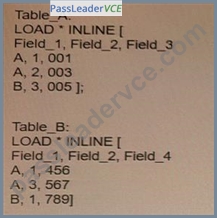
Refer io the exhibit.
A data architect needs to modify the script to ONLY load rows from Table_B when Field_1 and Field_2 are the same as in Table_A. (For example, only the row containing A, 1, 456 should be loaded from Table_B.) Which script should the data architect use?
A)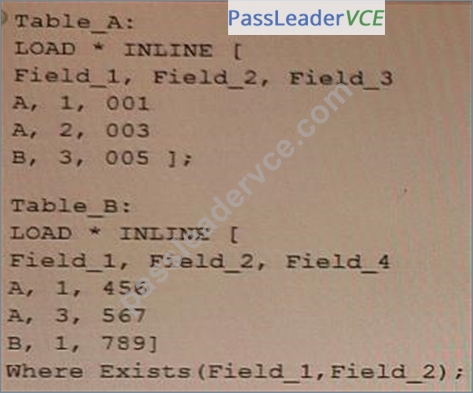
B)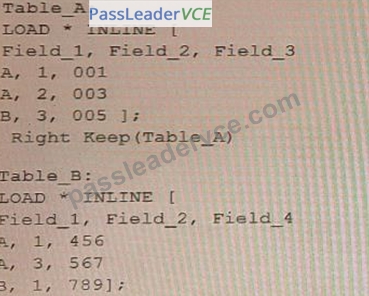
C)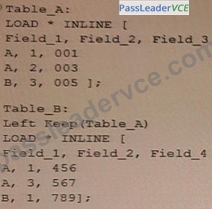
D)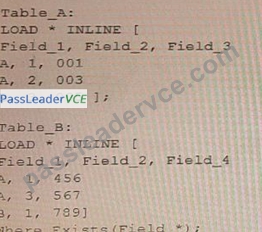
- A. Option C
- B. Option D
- C. Option B
- D. Option A
Answer: C
NEW QUESTION # 23
Refer to the exhibit.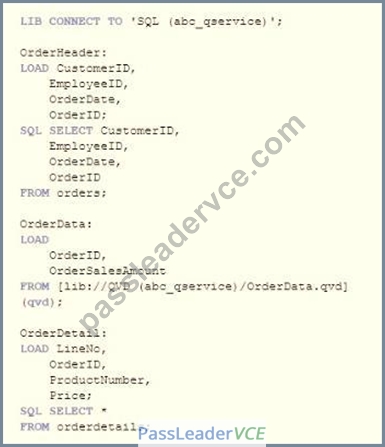
An existing app on Qlik Sense Enterprise is duplicated and transferred to a data architect to add some additional data When trying to manually reload the original script, the data architect receives an error What should be done to make sure the script runs correctly?
- A. Add the line lib connect to ' SQL (abc_qs9rvi.es) ' ;before the LOAD for the Order Detail table
- B. Add the line lib connect to 'QVD(abc_qservice/orderData.qvd) '; before the LOAD for the Order Data table
- C. Give the data architect the Read rights on the data connections in the QMC
- D. Make the data architect the owner of the app in the QMC
Answer: C
NEW QUESTION # 24
Refer to the exhibit.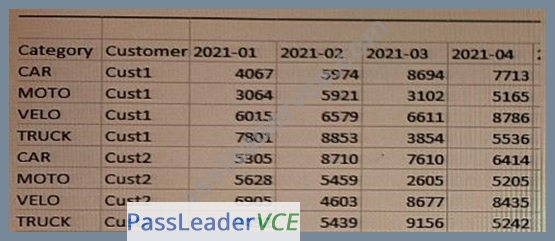
A customer needs to load forecast data from an Excel file.
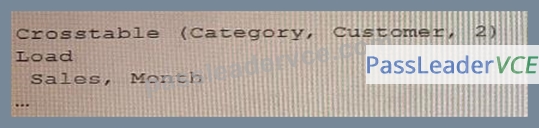
Which preceding load statement should the data architect use to load the data?
- A.
- B.
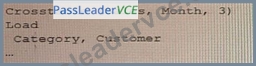
- C.

- D.

Answer: D
NEW QUESTION # 25 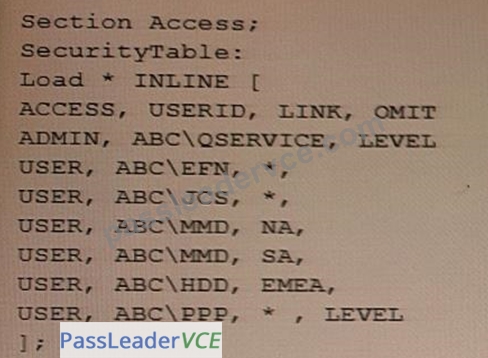
The Section Access security table for an app is shown. User ABC\PPP opens a Qlik Sense app with a table using the field called LEVEL on one of the table columns.
What is the result?
- A. The user gets a "Field not found" error.
- B. The user gets an "incomplete visualization" error
- C. The table is removed from the user interface.
- D. The table is displayed without the LEVELcolumn.
Answer: B
NEW QUESTION # 26
Refer to the exhibit.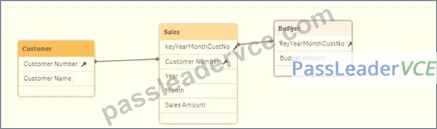
The data architect needs to build a model that contains Sales and Budget data for each customer.
Some customers have Sales without a Budget, and other customers have a Budget with no Sales During loading, the data architect resolves a synthetic key by creating the composite key For validation, the data architect creates a table containing Customer, Month. Sales, and Budget columns.
What does the data architect see when selecting a month?
- A. Customer and Budget records for that month, but missing values for Sales
- B. Customer, Sales, and Budget records for that month
- C. Customer and Sales records for that month, but missing values for Budget
- D. All Customers, all Budget and all Sales records
Answer: B
NEW QUESTION # 27
Refer to the exhibit.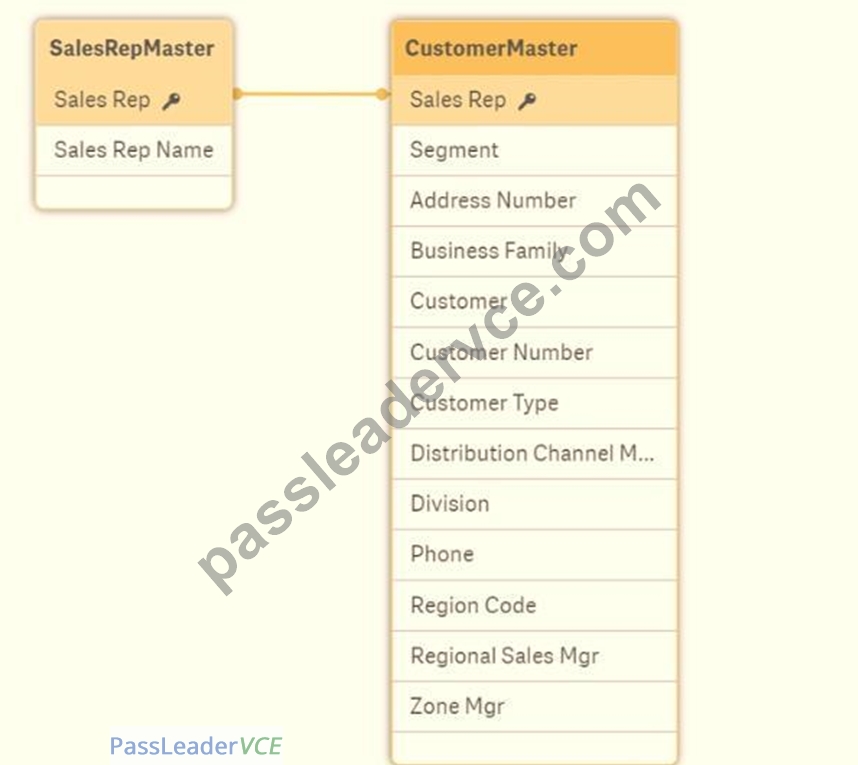
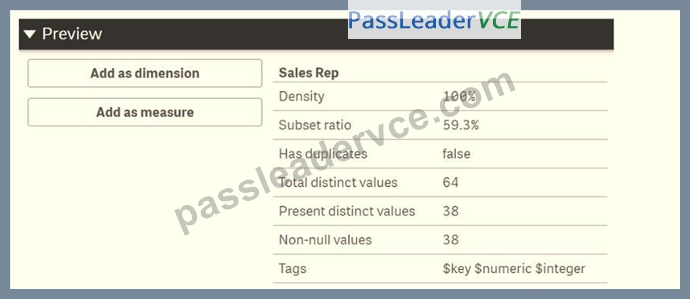
Refer to the exhibits.
While using an app, the users report that some Sales Reps do NOT have personal details, like Division or Address Number A data architect has been called in to investigate.
The data architect uses the data model viewer to determine the relationship between the SalesRepMaster and CustomerMaster tables.
What is the cause of the issue?
- A. 59.3% of the Sales Rep have CustomerMaster information
- B. Density is 100% while Total Distinct and Present Distinct are NOT the same
- C. 26 values for Sales Rep are null in CustomerMaster
- D. 40.7% of the Sales Rep have CustomerMaster information
Answer: B
Explanation:
Explanation
When using the data model viewer to investigate the relationship between the SalesRepMaster and CustomerMaster tables, the data architect would look at the density of the relationship. Density is a measure of how well the key fields of a table match the key fields of another table. A density of 100% means that all key fields in one table have a match in the other table.
When the density is 100% but the total distinct and present distinct values for the key fields of the related tables do not match, it means that some of the key fields in one table do not have a match in the other table, this is the cause of the issue.
NEW QUESTION # 28
A data architect needs to upload different data sources. To properly handle null values, the data architect decides to set all of these values to "Missing Value".
Which syntax should the data architect use?
- A. NullAsValue*;
Set NullValue = 'Missing Value'; - B. NullasNull *;
Set NullValue = 'Missing Value'; - C. NullasNull *;
Set NullValues = 'Missing Value'; - D. NullAsValue*; Set NullValues = 'Missing Value';
Answer: D
Explanation:
Explanation
This syntax will set all null values to "Missing Value" in the data sources. The other options are not valid syntax and will not achieve the desired result.
NEW QUESTION # 29
A data architect plans to build an app that contains geographically diverse data that must be specific to user run-time selections. The source contains transactional data. The app must have minimal impact on already limited server resources.
Which approach should the data architect use?
- A. QVDs
- B. Loop and Reduce
- C. ODAG
- D. In-memory
Answer: A
Explanation:
Explanation
Using QVDs is the best approach for this scenario, as it allows the data to be stored in a highly compressed format, which will have minimal impact on server resources. Additionally, QVDs can be loaded quickly, which allows for faster access to the data based on user run-time selections. The other options, Loop and Reduce, In-memory, and ODAG, are not valid strategies for this scenario.
NEW QUESTION # 30
Refer to the exhibit.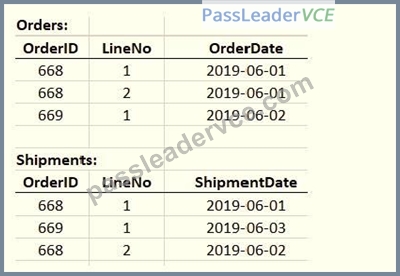
A data architect is loading the tables and a synthetic key is generated.
How should the data architect resolve the synthetic key?
- A. Create a composite key using OrderlD and LineNo
- B. Remove the LineNo field from Shipments and use the AutoNumber function on the OrderlD field
- C. Create a composite key using OrderlD and LineNo, and remove OrderlD and LineNo from Shipments
- D. Remove the LineNo field from both tables and use the AutoNumber function on the OrderlD field
Answer: A
Explanation:
Explanation
This is the recommended approach to resolving synthetic keys, as it allows you to maintain the integrity of the data by combining two or more fields into a single key. The composite key can then be used to join the two tables together, ensuring that the data is consistent and accurate.
NEW QUESTION # 31
A data architect completes development of a new app with two data sources Both data sources will also be used by other apps in the future The sources have different data refresh frequencies
* Source 1 Contains frequently updated data and must be refreshed hourly
* Source 2 Contains data that is transferred from a partner and must be refreshed weekly Tasks must be created to load the data sources and make sure that the new app uses the most current data The data will be stored in two QVDs Which tasks should be created to meet these requirements'?
- A. 1 Schedule Task 1 to run hourly and refresh data from Source 1
2 Schedule Task 2 to run weekly and refresh data from Source 2
3. Schedule a task for the app that is dependent on completion of Task 2 that loads the two QVDs - B. 1 Schedule Task 1 to run hourly and refresh data from Source 1
2 Schedule Task 2 to run weekly and refresh data from Source 2
3. Schedule a task for the app that is dependent on completion of Tasks 1 or 2 that loads the two QVDs - C. 1. Schedule Task 1 to run hourly and refresh data from Source 1
2 Schedule Task 2 that is dependent on Task 1 to refresh data from Source 2
3 Schedule a task for the app that is dependent on completion of Tasks 1 and 2 that loads the two QVDs - D. 1. Schedule Task 1 to run hourly and refresh data from Source 1
2 Schedule Task 2 that is dependent on Task 1 to refresh data from Source 2
3. Schedule a task for the app that is dependent on completion of Task 2 that loads the two QVDs
Answer: C
Explanation:
Explanation
This option ensures that the data in the two data sources is always up-to-date by scheduling the data refresh tasks to run at the appropriate frequencies. Task 1 runs hourly to refresh data from Source 1, and Task 2 is dependent on Task 1 so that it runs only after Task 1 is completed. This ensures that the data from Source 2 is loaded only after the most current data from Source 1 is loaded.
NEW QUESTION # 32
Refer to the exhibits.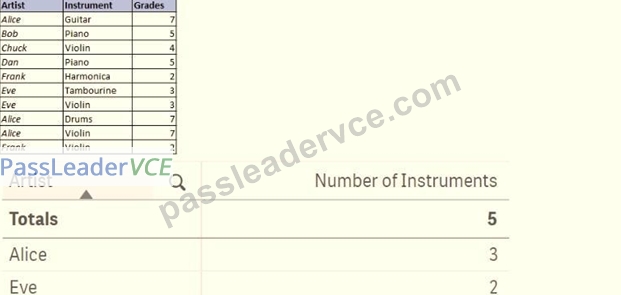
A music teacher needs to know which artists are eligible to enter this year's competition.
The teacher needs to find only the artists who have a music grade rank above two and play more than one instrument.
Which expression is needed for the Number of Instruments measure in the table?
- A. Count({$<Artist={"=Count(Instrument)>=2"}, Artist={"=Grade>2"}>}Instrument)
- B. Count ({S<Artist={"=Count(Instrument)>=2M}, Grades={">2"}>}Instrument)
- C. Count({$<Instrument={">=2"}, Artist={"=Grade>2"}>}Instrument)
- D. Count({S<Count(Instrument)={">=2"}, Grades={">2"}>}Instrument)
Answer: A
Explanation:
Explanation
The correct expression to use for the Number of Instruments measure in the table is Option A.
This expression will count the number of instruments played by artists with a music grade rank greater than two.
How to build a data architecture to drive innovation--today and ...
https://www.mckinsey.com/capabilities/mckinsey-digital/our-insights/how-to-build-a-data-architecture-to-drive- Big data in healthcare: management, analysis and future prospects ...
https://journalofbigdata.springeropen.com/articles/10.1186/s40537-019-0217-0 Obtaining Data From Electronic Health Records - Tools and ...
https://www.ncbi.nlm.nih.gov/books/NBK551878/
NEW QUESTION # 33
A human resources (HR) team manager is due to go on leave. The manager needs to assign permissions to colleague to help the HR team publish apps. Which action(s) should the manager assign to the colleague before going on leave?
- A. Publish, Read
- B. Owner Publish
- C. Owner Publish, Read
- D. Publish
Answer: B
Explanation:
Explanation
The Owner Publish permission allows the colleague to publish apps on behalf of the manager, allowing the HR team to continue to publish apps while the manager is away. The other options, Publish, Owner Publish, Read, and Publish, Read, do not provide the colleague with the necessary permissions to publish apps on behalf of the manager.
NEW QUESTION # 34
A customer has a dataset that contains latitude and longitude data for service points around the country. The data is retrieved using the following statement:
It must be clear to the end user that this is geographic data. Drag and drop, map-based visualization of this data is required. Which two steps should the data architect take to support this data? (Select two.)
- A. Add GeoProject{' Point' , Lat&Long) AS Point to the preceding load
- B. Add GeoKakePoint (Lat, Long} as Point to Location's preceding load
- C. Define Location as a master item, and set the tag to Sgeodata
- D. Add the following to the end of the script:
TAG FIELD LocationName With 'Sgeodata1, 'Srelated'; TAG FIELD Point With 'Sgeodata', 'Srelated1; - E. Add the following to the end of the script:
TAG FIELD LocationName With 'Sgeoname', *@relates_Pt';
TAG FIELD Point With 'Sgeopoint*f 'Srelates Location', '$hidden';
Answer: A,E
NEW QUESTION # 35
Refer to the exhibits.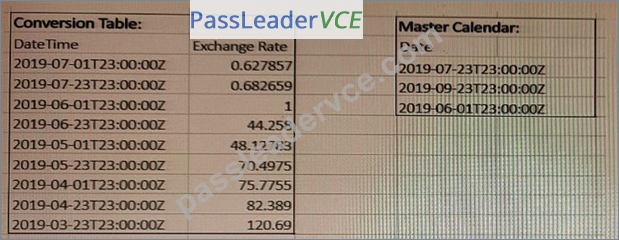
A business analyst needs to see the currency conversion provided by a third party process, and only contains a record when the rate changes in a chart. The currency conversion rate data is An existing master calendar exists in the data model that contains a full set of dates.
Which technique should the data architect use to meet this requirement?
- A. Use ITERNO and AUTOGENERATE to create a new calendar from max and min dates of the currency conversion table
- B. OUTER JOIN the calendar with the currency conversion table
ORDER BY the date and use the PEEK function to fill in blank values - C. Leverage a FOR loop between the start date and end date of the master calendar Use the MATCH function to add the currency conversion rates to the master calendar
- D. Utilize INTERVALMATCH to load the currency conversion rate between dates theconversation changed INNER JOIN the resultant table back into the master calendar
Answer: B
NEW QUESTION # 36
A data architect needs to develop a script to export tables from a model based upon rules from an independent file. Thestructure of the text file with the export rules is as follows:
These rules govern which table in the model to export, what the target root filename should be, and the number of copies to export.
The TableToExport values are already verified to existin the model.
In addition, the format will always be QVD, and the copies will be incrementally numbered.
For example, the Customer table would be exported as:
What is the minimum set of scripting strategies the data architect must use?
- A. One loop and two IF statements
- B. Two loops and one IF statement
- C. Two loopswithout any conditional statement
- D. One loop and one SELECT CASE statement
Answer: D
Explanation:
Explanation
The data architect will need to use a single loop to iterate through the rows of the independent filecontaining the export rules. Within the loop, they will need to use a SELECT CASE statement to determine which table in the model to export based on the TableToExport value in the current row of the independent file. They can then use the StoreAsFilenamevalue to determine the target root filename, and the NumberOfCopies value to determine the number of copies to export.
This approach makes use of a single loop to iterate through the rows of the independent file, and a SELECT CASE statement to determine which table to export based on the TableToExport value in the current row. It is the most efficient way to accomplish the task with minimal scripting.
You can find the Qlik scripting documentation for Store statement
here:https://help.qlik.com/en-US/sense/June2020/Subsystems/Hub/Content/Scripting/ScriptPrefixes/Store.htman SELECT CASE statement here:https://help.qlik.com/en-US/sense/June2020/Subsystems/Hub/Content/Scripting/ScriptStatements/Select.htm
NEW QUESTION # 37
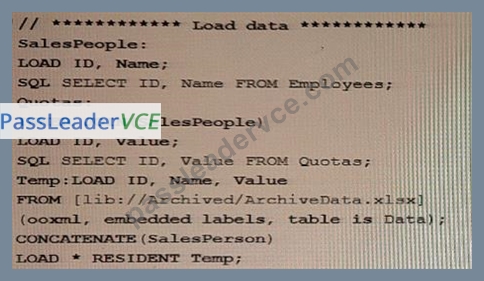
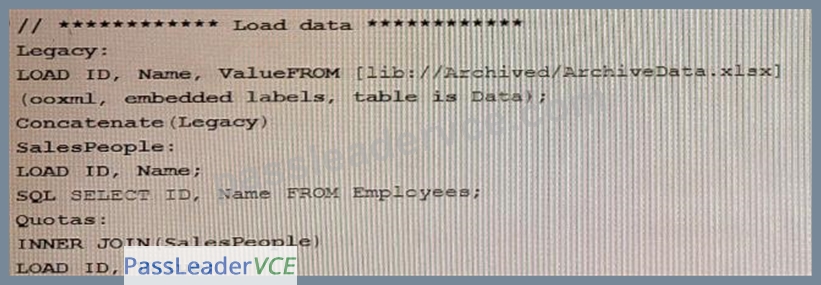
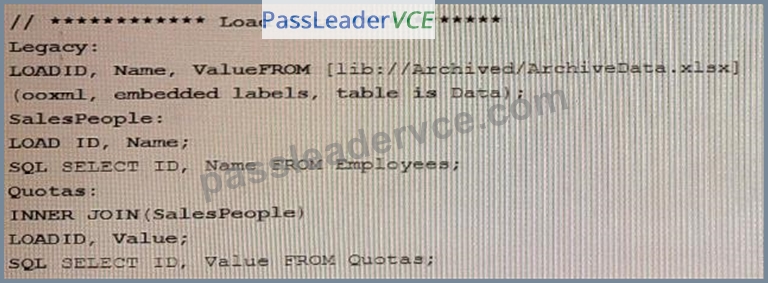
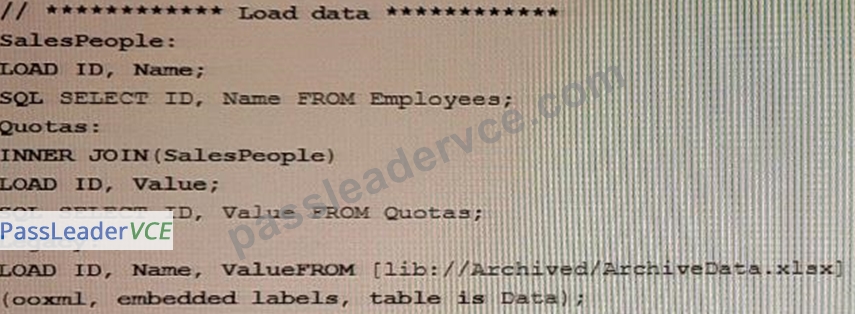
A data architect wants to combine data on present and historic sales performance.
The historic data is stored in a de-normalized archive, and the present data is maintained in a database.
The output must be contained in a single table.
Which script should the data architect use?
- A.
- B.
- C.
- D.
Answer: D
NEW QUESTION # 38
Users of a published app report incomplete visualizations. The data architect checks the app multiple timesand cannot replicate the error. The error affects only one team.
What is the most likely cause?
- A. A security rule has been applied to the sheet object
- B. Section access restricts too many records
- C. An Omit field has been applied
- D. The affected users were NOT added to the Section table
Answer: B
Explanation:
Explanation
Section access restricts access to certain records, and if too many records are restricted, it can lead to incomplete visualizations.Source: Qlik Section access is used to control access to the data in an app. If the section access settings are too restrictive, they can prevent certain users or teams from seeing all of the data they need, resulting in incomplete visualizations.
It is possible that the affected team has been assigned a section access that is too restrictive, preventing them from seeing all of the necessary data. This could be a misconfiguration or an oversight in the section access settings.
NEW QUESTION # 39
......
Qlik Certified QSDA2022 Dumps Questions Valid QSDA2022 Materials: https://pass4itsure.passleadervce.com/Qlik-Sense-Data-Architect/reliable-QSDA2022-exam-learning-guide.html