

Try Free and Start Using Realistic Verified PMI-RMP Dumps Instantly
PMI-RMP Actual Questions - Instant Download 205 Questions
PMI-RMP exam is designed to test the candidate's knowledge and skills in risk management. PMI-RMP exam covers various aspects of risk management, including risk identification, risk analysis, risk response planning, risk monitoring, and risk control. PMI-RMP exam is divided into five domains, which are risk strategy and planning, stakeholder engagement, risk process facilitation, risk monitoring and reporting, and performing specialized risk analysis. PMI-RMP exam consists of 170 multiple-choice questions and the duration of the exam is 3.5 hours.
PMI-RMP certification exam is an essential certification for professionals who are responsible for managing risks within projects. It covers a wide range of topics related to risk management and project management and requires a significant amount of preparation. Achieving the PMI-RMP certification can provide numerous benefits to professionals, including increased career opportunities, higher salaries, and enhanced credibility within their industry.
NEW QUESTION # 113
You are the project manager for a construction project. The project involves casting of a column in a very narrow space. Because of lack of space, casting it is highly dangerous. High technical skill will be required for casting that column. You decide to hire a local expert team for casting that column. Which of the following types of risk response are you following?
- A. Acceptance
- B. Avoidance
- C. Transference
- D. Mitigation
Answer: C
NEW QUESTION # 114
Frank is the project manager of the NHH Project. He is working with the project team to create a plan to document the procedures to manage risks throughout the project. This document will define how risks will be identified and quantified. It will also define how contingency plans will be implemented by the project team. What document is Frank and the NHH Project team creating in this scenario?
- A. Project plan
- B. Resource management plan
- C. Risk management plan
- D. Project management plan
Answer: C
NEW QUESTION # 115
The project risk manager for an environmental preservation project has started the process of monitoring and controlling risks, The project manager has asked the project team to document the results of this process.
How should this documentation be utilized in the future?
- A. To ensure information is recorded for lessons learned
- B. To return the remaining amount of the contingency reserve
- C. To hold those who created the risk accountable
- D. To comply with the rules and regulations
Answer: A
Explanation:
Documenting the results of the risk monitoring and controlling process is important for creating lessons learned. This helps future projects by providing a reference for risk management practices and experiences.
The documentation of the results of monitoring and controlling risks is a valuable source of information for lessons learned. Lessons learned are the documented information that reflects both the positive and negative experiences of a project. They represent the organization's commitment to project management excellence and the project manager's opportunity to learn from the actual experiences of others. By documenting the results of monitoring and controlling risks, the project team can capture the effectiveness of the risk responses, the changes in the risk exposure, the root causes of the risks, the best practices and the lessons learned for future projects. This documentation can help to improve the risk management process, enhance the project performance, and increase the organizational knowledge base. Reference: PMI Risk Management Professional (PMI-RMP) Examination Content Outline and Specifications1, page 10; A Guide to the Project Management Body of Knowledge (PMBOKGuide) - Sixth Edition, page 406; Lessons learned - PMI.
NEW QUESTION # 116
In addition to monitoring and controlling the project risks for their status and information the risk monitoring and controlling process accomplishes four key things for a project. Which one of the following is NOT a determination that is made by the risk monitoring and controlling process?
- A. Determines if the project assumptions are still valid
- B. Determines if the risk contingency reserves should be modified to be in alignment with the current risk assessment
- C. Determines if the project constraints are still valid
- D. Determines if the risk management policies and procedures are being followed
Answer: C
NEW QUESTION # 117
Gary is the project manager for his organization. He is working with the project stakeholders on the project requirements and how risks may affect their project. One of the stakeholders is confused about what constitutes risks in the project. Which of the following is the most accurate definition of a project risk?
- A. It is an uncertain event or condition within the project execution.
- B. It is an unknown event that can affect the project scope.
- C. It is an uncertain event that can affect at least one project objective.
- D. It is an uncertain event that can affect the project costs.
Answer: C
NEW QUESTION # 118
A project manager was informed that the testing of the latest component in the project's software update release was not successful. As a result, 1he delivery timelines for the software release wifi be delayed, The project manager did not previously capture this as a risk to the project.
What should the project manager do next to avoid similar risks?
- A. Reassess risks with a new assumptions and constraints analysis.
- B. Review the risk response plan looking for lessons learned.
- C. Log the event in the issue log and update the project management plan.
- D. Add contingencies to other tasks to mitigate similar risks.
Answer: A
Explanation:
Explanation
The project manager should reassess risks by conducting a new assumptions and constraints analysis. This will help identify any previously overlooked risks and ensure that the risk register is comprehensive and up-to-date.
NEW QUESTION # 119 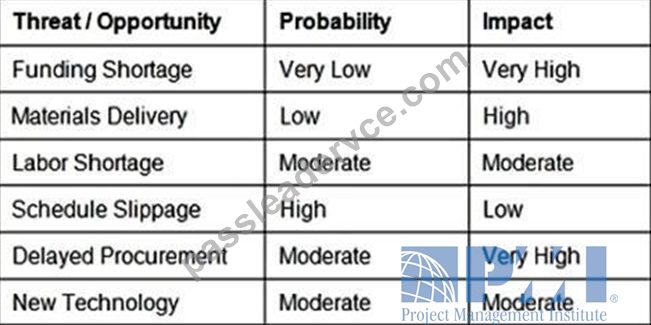
Based on this information, which of the following has the highest risk exposure?
- A. Schedule slippage
- B. Funding shortage
- C. Delayed procurement
- D. Labor shortage R
Answer: C
NEW QUESTION # 120
You are the project manager for your company and a new change request has been approved for your project. This change request, however, has introduced several new risks to the project. You have communicated these risk events and the project stakeholders understand the possible effects these risks could have on your project. You elect to create a mitigation response for the identified risk events. Where will you record the mitigation response?
- A. Risk management plan
- B. Risk register
- C. Project management plan
- D. Risk log
Answer: B
NEW QUESTION # 121
A newly assigned project manager is reviewing the project documents with stakeholders to identify opportunities that will fast track the project and realize the financial benefits of early completion. What document should be updated at the end of the review?
- A. Risk register
- B. Risk response plan
- C. Risk identification plan
- D. Risk management plan
Answer: D
NEW QUESTION # 122
You are the project manager of the GHG project. You are preparing for the quantitative risk analysis process. You are using organizational process assets to help you complete the quantitative risk analysis process. Which one of the following is NOT a valid reason to utilize organizational process assets as a part of the quantitative risk analysis process?
- A. You will use organizational process assets for studies of similar projects by risk specialists.
- B. You will use organizational process assets for information from prior similar projects.
- C. You will use organizational process assets for risk databases that may be available from industry sources.
- D. You will use organizational process assets to determine costs of all risks events within the current project.
Answer: D
NEW QUESTION # 123
Frank is the project manager of the NHQ project for his company. Frank is working with the project team, key stakeholders, and several subject matter experts on risks dealing with the new materials in the project.
Frank wants to utilize a risk analysis method that will help the team to make decisions in the presence of the current uncertainty surrounding the new materials. Which risk analysis approach can Frank use to create an approach to make decisions in the presence of uncertainty?
- A. Qualitative risk analysis process
- B. Quantitative risk analysis process
- C. Monte Carlo Technique
- D. Delphi Technique
Answer: B
NEW QUESTION # 124
A risk manager faces resistance as they try to implement the project's risk strategy. Some members of the project team believe it is a waste of time and money, What should the risk manager do?
- A. Meet with team members to address their concerns.
- B. Reduce the number of risk management activities.
- C. Raise the concerns with the project sponsor,
- D. Continue to implement the risk strategy
Answer: A
Explanation:
Explanation
When facing resistance from team members, the risk manager should engage in open communication to address their concerns and clarify the importance of risk management in the project.
NEW QUESTION # 125
A project manager works on a long-term and high visibility project at an organization that has a low risk appetite towards this project due to its impact on the company's business. The project sponsors follow up weekly with the project manager, who was just informed by one of the risk owners that the exposure from two high-impact risks are hitting the risk thresholds.
What should the project manager do next?
- A. Perform an assumptions and constraints analysis.
- B. Implement mitigation measures for those risks.
- C. Complete an assessment and confirm the response with the sponsors.
- D. Update the project management plan to add contingency.
Answer: C
Explanation:
Explanation
The project manager should complete an assessment of the high-impact risks and confirm the response with the project sponsors (C) since the organization has a low risk appetite for this project. This approach ensures that the sponsors are aware of the situation and can provide guidance on how to proceed. This is in line with PMI's PMBOK Guide, Sixth Edition.
NEW QUESTION # 126
A project manager is hired as a consultant by the executive sponsor to manage a major change program that has experienced two past failures. The current executive sponsor believes the project is in good shape based on feedback from the last project manager and reports this to senior executive management. The executive sponsor believes there were no major risks threatening the time, budget, or quality of the project. In the first week of risk analysis, the project manager concludes the project timeline is unrealistic and is three months behind schedule. The organization's risk appetite is low.
What is the first step that should be taken?
- A. Immediately call a steering committee meeting, report the project status, and suggest project scope reductions to save time.
- B. Review the project schedule and recommend fast tracking the schedule and/or crashing the critical path.
- C. Discuss the project schedule with the executive sponsor and agree on a strategy for updating the risk management plan and risk response plans.
- D. Update existing risk response plans and include more resources to get the project back on track.
Answer: C
NEW QUESTION # 127
The risk manager is facilitating risk planning activities with the team. The team is documenting all the check points along the way that might indicate delays on critical deliverables.
What is this an example of?
- A. Risk responses
- B. Risk registers
- C. Risk categories
- D. Risk triggers
Answer: D
Explanation:
Explanation
The team is documenting all the checkpoints along the way that might indicate delays on critical deliverables, which is an example of risk triggers. Risk triggers are events or conditions that indicate a risk may be about to occur or has already occurred, helping the project team to monitor and respond to risks effectively.
NEW QUESTION # 128
......
PMI-RMP certification exam is designed for professionals who are involved in risk management activities in their organizations. PMI Risk Management Professional certification exam covers various aspects of risk management, including risk identification, risk analysis, risk response planning, risk monitoring and control, and risk communication. PMI-RMP exam is intended to test the candidate's ability to apply risk management concepts and techniques in real-world situations.
Download Free Latest Exam PMI-RMP Certified Sample Questions: https://pass4itsure.passleadervce.com/Project-Management-Professional/reliable-PMI-RMP-exam-learning-guide.html